Your place to ask questions that there aren't time for during courses, and continue your training after your course is over. Aside from answering questions I will talk about different range drills, firearms tips and techniques, maintaining a defensive mindset, and firearms reviews.
Showing posts with label personal defense. Show all posts

Saturday, January 19, 2013

Thoughts on Semi-Automatic Rifles: Part 2

As promised, I am coming back and looking at some of the issues surrounding semi-automatic rifles in this post as well.  While not the most scientific method available for determining how often a type of rifle is used in a crime, the FBI's Uniform Crime Reports do keep track of murders every year, and what weapons are most commonly used.  I say not the most scientific, because I realize that firearms can be used in other crimes than homicides, but, I think it provides a good baseline.  In 2011 (the full 2012 report hasn't been released yet) rifles (of all types, not just semi-automatics) were used in about 340 homicides out of a total of 14,612 homicides, which means about 2% of them.  You can go back to about 1960 in the UCR, and you will see that rifles traditionally are not used to murder people in America.  Usually both knives, as well as the hands/feet/fists section is responsible for more murders annually than rifles.

This brings up a very interesting question of why these rifles are demonized so much by politicians and the media, since they account for such a small percentage of criminal firearms use.  As I already mentioned in the last post, calling these rifles "assault rifles" or "assault weapons" is inaccurate and dishonest, and the criteria for what designates a rifle as one is generally rather absurd.


The text of the new ban that is expected to be introduced in the legislature has not yet been completely released (remember to be contacting your legislators and telling them to not support any new restrictions on our Second Amendment rights), so I am just going to use the previous ban to show how little sense these bans usually make.  Under the 1994-2004 ban, a rifle was banned if it was fed by a detachable box magazine, and had two or more of the following:


  • A folding or telescoping stock
  • A pistol grip
  • Bayonet mount (bayonet lug would be the proper terminology)
  • Flash suppressor, or a threaded barrel to accept one
  • Or a muzzle mounted grenade launcher
It also included pistols that had two or more of the following:
  • Magazine that attaches outside the pistol grip
  • Threaded barrel
  • Barrel shroud that can be used as a forward grip
  • Unloaded weight of more than 50oz
  • A semi-automatic version of a fully automatic firearm
And semi-automatic shotguns with two or more of the following
  • Folding or Telescoping stock
  • Ability to accept a detachable magazine
  • Fixed capacity of more than 5 rounds
  • Pistol Grip
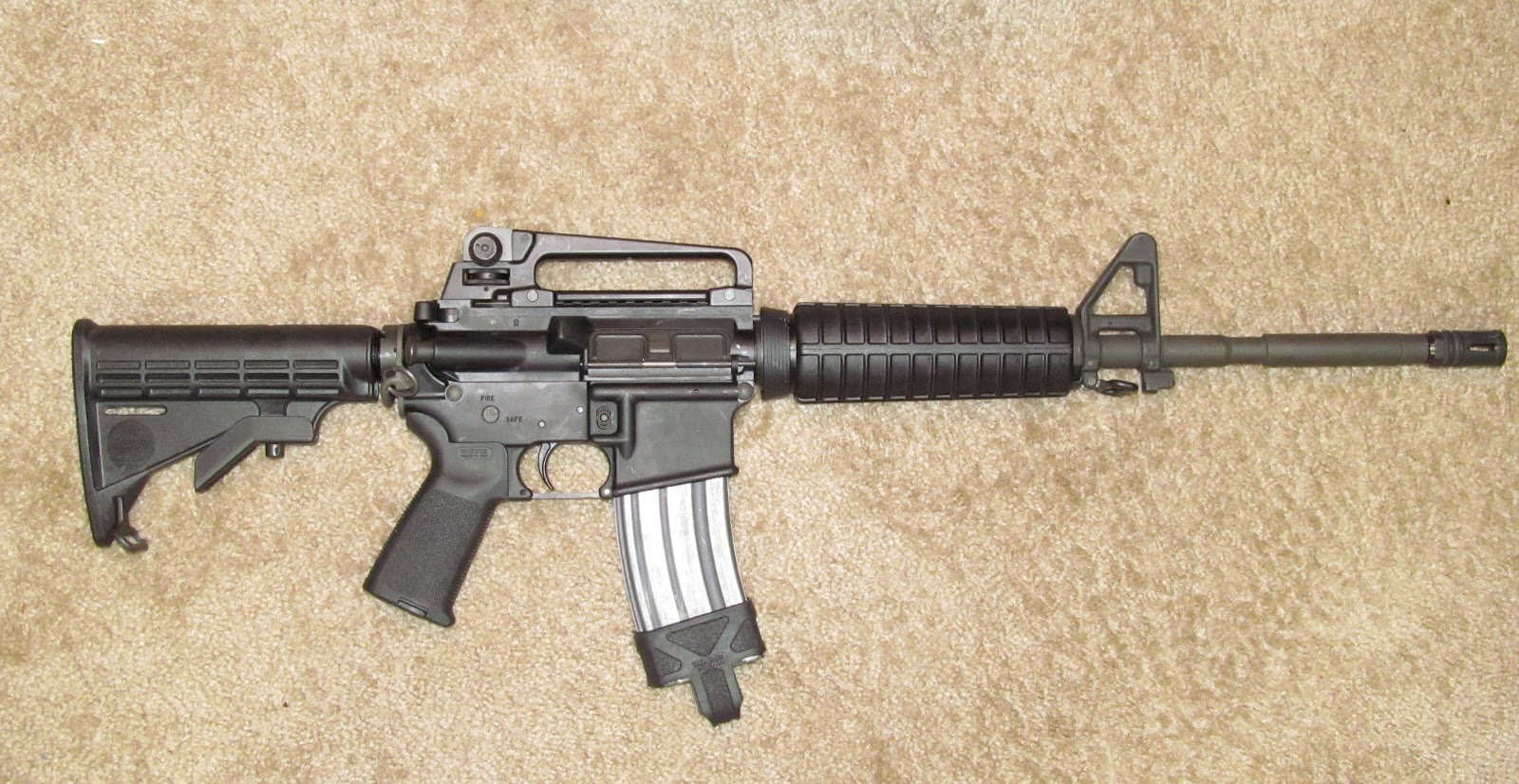
There were also some firearms that were specifically prohibited by name in the ban.  For the purpose of this post however, I am just focusing on rifles.  So, under the previous ban, this rifle was prohibited:


However, this one would not be:


Both are actually the same rifle, a Ruger Mini-14 ranch rifle, which by the way in not a military rifle.  All I did was change out the stock with an aftermarket one.  Both versions have the exact same capabilities, it doesn't change how fast the rifle can be fired, or the round the rifle fires (.223 Remington, which is for practical reasons the same round that an AR-15 fires). With a folding stock the overall length is about 8 inches shorter with the stock closed.  But, there is still a minimum length that a rifle needs to be in order to not be a class 3 firearm, and even with the stock closed, the rifle is over that length.  At almost 30" long, it still isn't concealable.  So, I am going to take a look at the features specified for rifles, and offer some reasons why it is good for rifles to have them.

  • Folding or telescoping stock: First I don't particularly like folding stocks, and the Mini-14 is the only rifle I have that has one.  I don't like them because most of them don't lock up very tight, or allow the shooter a good cheek weld, which means that they generally make the rifle more uncomfortable to shoot.  But, a lot of people like the way they look, and if you are in a situation where you want to save space, they can make sense.  Telescoping stocks also have value as well.  It is a basic fact of life that people come in different shapes and sizes, and because of that, telescoping stocks are a great thing.  It means that two different people can shoot the same rifle, and just adjust the stock for a different length of pull, and do so comfortably.  I didn't realize that it was a bad thing to be able to customize a firearm to the shooter so that they can have a proper stance and eye relief to shoot it accurately.  Full sized stocks are too long for some people to shoot comfortably.  It also means that you don't necessarily need to buy a youth firearm for a child to learn on, that he will eventually outgrow.  You can buy a rifle with a folding stock, and extend it as the child grows, allowing him (or her) to keep that rifle they are familiar with.  
  • A pistol grip: I guess some people think that they make a rifle look scary, but for the past 60 or so years, rifles with pistol grips have been around, and commonly available.  They actually make a rifle harder to conceal due to the added bulk, so they don't really effect that.  If you are strong enough to shoot a rifle one handed with a pistol grip (not something I advocate by the way), then you could do it with a normal stock.  It really is just a design that allows you to grip the rifle in a slightly different manner, and does nothing to enhance the capabilities of the rifle.
  • Bayonet mount:  I have yet to see a single crime report where a rifle with a bayonet is used in a violent crime.  If anyone knows of any crimes committed with a rifle that had a bayonet attached in the last century, I would actually be very interested to see it.  Bayonets add length to a rifle, and make them a bit more unwieldy in confined spaces, and pretty much impossible to conceal unless you want to cut yourself.  Which should be a good thing, right?  If telescoping and folding stocks aren't allowed because they make the rifle shorter and easier to hide, then isn't something that does the opposite desired?  If a criminal is already using a rifle (which they rarely do anyways), what difference does it make if there is a bayonet or not on the end of it?  I would be more concerned about the rifle attached to the bayonet if presented with the threat.
  • Flash suppressor, or threaded barrel to accept one:  Many rifles, including many bolt actions, have threaded muzzles in order to allow different muzzle attachments to be added.  I personally think this prohibition was more about the ability to add a sound suppressor than the flash suppressor, since most sound suppressors use threading to attach.  Sound suppressors, by the way, are a Class 3 restricted NFA item, that requires special procedures to purchase, and are already heavily controlled.  But, back to flash suppressors.  If I have to defend myself at night and am using a rifle, I would like to be able to see after the first shot, which a flash suppressor would help me be able to do.  Most also are designed in such a way that gasses are controlled in a way to help reduce muzzle climb.  I personally think that being able to control my firearm while I am firing it for the safety of myself and anyone else around me is a good thing.
  • Grenade launcher:  This is not actually talking about externally mounted launchers, like a M-203, but muzzle mounted devices.  Before the advent of the standalone or under barrel style grenade launchers,  many rifles had muzzle devices that you could mount on the muzzle of the rifle.  Then, using special rounds, you would fire the rifle, and launch the grenade.  It is not the most effective method to launch a grenade, because it means you can't use your rifle at the same time.  And aside from that, I have never once seen such a grenade available to purchase by the general public, because explosive are very heavily controlled.  So really, what difference does an extra inch or two of metal on the muzzle of my rifle make?  Some rifles were just imported with them, its not like they add any capability to the rifle without a grenade to launch. Similar to the bayonets, if anyone knows of a muzzle mounted grenade launcher being used to be launch a grenade from a rifle in the last century, I'd be interested to hear about it.  
None of these features really has anything to do with enhancing the capabilities of a rifle.  They are all cosmetic features that some people don't like the way they look, they think that they make the rifle look "scary."  To me it shows the absurdity of banning firearms based on just those features. Although I think firearms bans in general are absurd, because they only effect law abiding citizens and not criminals, so I am sure that I am biased.  

Monday, January 14, 2013

Thoughts on Semi-Automatic Rifles; Part 1


I am going to spend probably the next few posts tackling the issues surrounding modern semi-automatic rifles, often given the misnomers of "assault rifles" or "assault weapons."  Words have power, they are used to influence how people think about a topic.  Some words develop negative connotations, and are then mis-used to confuse those who are not knowledgeable about the topic.  So, I will be using proper terminology in this post, and would encourage everyone else to do the same.  First "assault weapon" is not a classification for a type of firearm, it is just a term that was made up, probably because it can be used to scare and confuse people.  Taking the definitions of the words from the Merriam-Webster dictionary:

Assault: a : a violent physical or verbal attack

b : a military attack usually involving direct combat with enemy forces
c : a concerted effort (as to reach a goal or defeat an adversary)

Weapon:
a : something (as a club, knife, or gun) used to injure, defeat, or destroy
b : a means of contending against another
So, an "assault weapon" is something used to injure, defeat or destroy in a violent physical or verbal attack.  That could be pretty much anything, from a fist, to a rock, to a ballpoint pen to a thermonuclear weapon.    If you can cause harm with it, it is an "assault weapon".  

Assault rifles on the other hand, have an actual definition as a classification of firearms, coined by the Nazis in World War 2.  An assault rifle is a select fire,  shoulder fired rifle, that is fed by a detachable box magazine, and fires an intermediate cartridge.  The major difference between civilian rifles and those used by the police and the military is that "select fire" bit.  For those who may not understand the significance of that, a select fire firearm has some sort of fully automatic capability, either truly fully automatic, or a multiple shot burst capability.  No matter which setting the firearm has (some have both burst and fully automatic) the gun has the capability of firing more than one round for every pull of the trigger.The vast majority of civilian rifles are semi-automatic only, which means one bullet fired for every pull of the trigger.  These rifles can not be easily or safely converted to fully automatic without parts that are strictly regulated and require more stringent background checks than normal firearms purchases.  They may look similar to actual assault rifles, but the way they operate and function is different.  I did say vast majority of civilian rifles, because there are a very limited number of fully automatic firearms in civilian hands, but they have been heavily licensed, regulated and taxed since 1934, and no more have been made available since 1986.  There are a lot of hoops to jump through for civilians to own one of these rifles, and it is a time consuming and expensive process.  
So, jumping into some of the arguments that I have heard against semi-automatic rifles lately, and offering some counter points.  "These rifles don't have any sporting or hunting use."  That is actually quite false.  Aside from the fact that the Second Amendment has nothing to do with sporting or hunting, I have gone hunting with an AR-15, as do hundreds of thousands of other Americans every year.  The round is a bit anemic for deer, however, in the great land that is America, there is a lot more to hunt than deer.  I have taken my AR-15 out coyote hunting, and for that it is a logical choice.  It is accurate, easy to mount an optic and flashlight on for night and low light hunting, the .223 has great ballistics on coyotes, and the fact it is semi-automatic and has low recoil allows for fast follow up shots.  The AR-15 is a very common varmint and predator rifle in America, and used by many for hunting.  Also, it has taken over the world of high power service rifle competitions.  A majority of competitors at Camp Perry for the National Matches now shoot AR-15 variants.  It also is used by many competitors in a sport that is called 3-gun.  So, the rifles have a use as both hunting and sporting arms.  
"You don't need any more than X bullets to defend yourself."  I really wish that I had the psychic ability of these people to predict what I may need in the future.  If so, I would know when I would need a gun to defend myself, and not show up to the encounter.   Nobody knows the future, and what encounters others may face.  Last night around Cincinnati there was an armed home invasion that had six suspects (link to the news story: http://www.wcpo.com/dpp/news/local_news/6-suspects-remains-at-large-following-elmwood-place-home-invasion#ixzz2HwfsTfY8).  That makes 7 or 10 rounds seem wanting.  Anyone who has ever been in a gunfight can tell you that it is not like the movies.  It is a very dynamic, chaotic, confusing, terrifying experience, and is very different than standing at a shooting range punching holes in paper.  When you start adding multiple threats into the situation, being ham-stringed by magazine capacity limits could get law abiding people killed.  Aside from that, what the media calls "high capacity magazines" are actually standard capacity, and have been for the past 50 or so years.   
"The Founders couldn't have imagined rifles like this when they wrote the Constitution, they meant muskets!"  Well, no, probably not, but, they had just defended themselves against a tyrannical government using munitions equal to or better than those being used against them.  Colonists who were able to were encouraged to buy cannons, and a single 1770s cannon round can do far more damage than a single round from a 5.56 rifle.  I am also pretty sure that the Founders could never have envisioned the advent of blogging or the internet, but like to think that this post, and all my other ones, are covered by the First Amendment.  If not, I guess that I should buy a Gutenberg printing press and use that to share my thoughts with the world.  The Founding Fathers were extremely wise men, and they intended for the Constitution to last for generations of Americans.  Had they not done so, they would have specified restrictions on our rights based on technology at their times.  As an extra historical note, the Pennsylvania long rifles that some Revolutionary War soldiers carried was superior to the issued Brown-Bess musket issued to the British troops.  The advent of rifled bores meant that the rifles were more accurate at longer ranges than the muskets.  
I think that is enough of a primer to get people thinking, if anyone has any feedback or questions, please let me know.  You can either leave a comment on here, or find us on Facebook or Twitter (@lmtactical).   The next post should look more in depth at modern semi-automatic rifles, and their uses, and purposes for civilians in modern society.

Monday, October 22, 2012

Training When the Weather Turns Cold

Here in Ohio it is definitely fall, and the weather is starting to turn colder, which it will continue to do until everything thaws out next spring.  So, I thought I would dedicate this post to giving some ideas for how to train when the weather is less than perfect.

The best way to train, is just like you would if the weather was perfect.  Cold, windy, overcast day?   Great, put on a coat, and go to the range!  Not only is it more likely you will be the only person there, so you can optimize your training time, but I am a firm believer in training like you will fight.  I will add a caveat here.  I understand that some people view firearms as purely for recreation or sport, and don't really think about them as defensive tools.  If you fall in that category, then maybe you are content with just shooting when it is nice outside, or indoors.

But, if you carry a firearm for defense, do you just carry it outside when it is 75 degrees and sunny?  Then why would that be the only time that you go to the range?  The changing seasons bring new challenges to carry a defensive sidearm, and your training should reflect that.

Odds are that you are wearing more, heavier layers of clothing.  Have you practiced drawing with those extra layers on?  There is a big difference between just sweeping a t-shirt out of the way, as opposed to a winter coat.  The winter coat allows you to conceal a full-sized handgun easier, but also complicates the draw.  So, go to the range wearing your seasonally appropriate outerwear, and practice drawing, and firing in it. Are the sleeves positioned in such a way that you can move adequately to draw and fire?  Or do they restrict your movement?

Equally important, do you wear gloves when your hands get cold?  When is the last time that you tried drawing and shooting your handgun, or even just shooting your handgun, with those gloves on?  Is the trigger guard on your pistol big enough that you can get your gloved finger into position?  Do you know how to index your finger on the trigger to pull slow, steady, and straight to the rear while wearing your gloves?  What about operating the rest of the controls on your pistol with gloves on?  Or performing malfunction drills?  Or reloads?   If you are going to be wearing gloves, these are things you need to consider.

As the days get colder, they also get shorter.  It is not uncommon for people to leave in the morning for work when it is dark, and then get back home after the sun has already set in the evening.  If this sounds like your winter, when is the last time that you tried to do any low-light shooting?  Does your pistol have night sights or a laser to help you properly index your shots before firing them?  Have you taken the time to check the zero if it does?  Are you carrying some sort of hand held flashlight to illuminate any potential targets?

These are all things that people who don't live in tropical paradises need to consider as the seasons change, because they should affect your gear, tactics and training.  You don't necessarily need to go out to the range in a monsoon, but if you do, more power to your.  You will almost certainly be the only person there.  But, when we as humans experience discomfort, like being cold, we tend to start to internalize everything, and just focus on our own misery.  If you go to the range when you are in such a state of mind, it will force you to stop internalizing, and focus on other things, like firearms safety, and how well you are shooting.  So, it adds a little bit of adversity to your range trip, which will help you get outside you comfort zone, and push yourself, to increase your skills.

You can always hop in the car and crank the heater on the way home, so there really is no excuse for not training in less than perfect weather.  It will teach you a lot about your gear, and more importantly, about yourself.

Sunday, October 14, 2012

After Action Report: "The Bulletproof Mind" with LtCol. Dave Grossman


I had the opportunity yesterday to attend a Bulletproof Mind seminar, put on by Buckeye Firearms Association.  In my opinion, training doesn't do any good if you don't take the time to analyze and reflect on the experience in some way, hence why I am writing an "after action report."

I will be upfront and say that I was biased in a positive way towards LtCol. Grossman even before attending this seminar.  I have had a copy of his book "On Killing" for several years, and it actually traveled with me to both Iraq and Afghanistan.  I read it a few times while in the service, once before my first deployment, and then again while I was in Afghanistan.  And several others in my platoon read my copy as well, especially in Afghanistan, where we had a fair bit of kinetic contact with the Taliban.  And it seemed to do a lot of good for a lot of us, and helped my friends understand what was going on in their heads.  So, I already had high hopes for the seminar yesterday.

I am a firm believer that you have to train the "software" just as much as the "hardware" when it comes to self defense.  If you are serious about self defense, you use your defensive mindset every single day.  You may be carrying your gun every day, but you certainly don't need to shoot it in defense everyday.  Your mind is actually your single best defensive weapon, and you can probably avoid or deter the vast majority of threats, just by being alert and observing your surroundings, and recognizing a threat when you see one.  So, if all your self defense training consists of is going to the range and punching holes in paper, to me, it is deficient, and you should expand your horizons.

I am not going to try to paraphrase or give away any of what LtCol. Grossman covers in his seminar.  But, some of the topics covered include:


  • Current threats in society, and some of the causes for violence in society.
  • Possible future threats that society will face
  • Some of the Psychological aspects of self defense
  • Physiological reactions to threats
  • The psychological aftermath of a defensive shooting


I really enjoyed the seminar, and got a lot out of it.  I think that it was a good reminder of why I go through the daily hassle of strapping on a pistol before I head out the door.  If you have been getting lax in your carry habits, it might be a good thing to attend the seminar.  I would also very highly encourage any recently returned veterans who have been deployed to combat overseas to attend, as someone who fits that category, I found it extremely worthwhile.  I personally also think that it could be quite beneficial to someone who is on the fence about carrying for self defense, or even  anti-gun people, if they would attend.  I think it could help pull the wool from over their eyes, and see what is going on in society.  LtCol. Grossman conveys the information in an intelligent manner without any false bravado, and does an excellent job of keeping the crowd involved and interested.

So, if you have a chance to attend one of these seminars, or anything else presented by LtCol Grossman, I would highly recommend you take the chance.  It is just as valuable as a day at the range, and will help round out your defensive training, adding more tools to your tool box.  I actually thought the day went extremely fast, and at no point was looking at my watch wondering when it was going to end.  I also like that the BFA does this as a fundraiser, it is well worth the money, and I have no problems with giving them money with all the work they have done for us in Ohio, especially the month before an election.  You can also pick up his books, or some books he was written forwards or had other input on, up at the seminar without needing to pay for shipping (I bought a copy of "On Combat," and added several more to my wishlist.)  And, if you have an old dog-eared copy of one of his books that traveled the world with you you can probably get it signed, and have a minute with him to talk about where the book has been.

Sunday, August 19, 2012

Some Magazine Basics


One topic that people seem to confuse on a rather regular basis is what is a magazine, and what is a clip.  In the picture above there are both magazines, and clips.  First are the four magazines, starting from the left, a 30 round AK-variant magazine, a 30 round Magpul Pmag for 5.56 rifles, a 15 round Sig 226 9mm magazine, and a 6 round .45 ACP Glock 36 magazine.  On the right side are two clips, a stripper clip holding 10 5.56x45 cartridges, and a 5 round stripper clip holding 7.62x54R for Mosin Nagant rifles.  When looking at the two groups above, it is easy to see that there are some differences between magazines and clips.

So, what are the functions of each respectively?  The four detachable box magazines are used to hold ammunition in a semi-automatic firearm, and able to be quickly replaced.  They are inserted into the magazine well, and remain in place while operating the firearm.  The clips, on the other hand, are used to reload magazines.  The Mosin Nagant rifle, and the vast majority of other bolt action rifles, have non-detachable box magazines.  This means that they are internal to the rifle, and are usually loaded through the top of the action, with the bolt pulled to the rear.  Instead of having soldiers try to load loose rounds by hand in the heat of battle, most military bolt action rifles had the ability to be loaded with stripper clips.  The bolt was pulled to the rear, the clip placed into some guides cut into the receiver, and then the rounds pushed down into the magazine.


Stripper clips can also be used to reload detachable box magazines.  As you can see in the picture above, there are metal stripper clip guides that can be placed onto magazines.  Then you insert the stripper clips into the guide, and simply push the bullets down into the magazine.  Loading a 30 round AR-style rifle magazine with 3 stripper clips is a whole lot easier and faster than loading 30 loose rounds by hand.  


Magazines really are rather simple mechanical devices, but the picture above shows the components, which are common for either pistol or rifle magazines.  There is the magazine body, a piece of metal or plastic formed to hold the rest of the components.  The magazine follower, which is the usually plastic piece on top of the spring, which is that the last round in the mag pushes against.  The spring itself, which may or may not have a plate on the bottom to help keep it level and from binding, and the base-plate.  

Even though they are so simple, there are a number of things that can cause a magazine to malfunction.  In semi-automatic firearms, a very high percentage of malfunctions are magazine related.  The springs can go bad with use over time, thankfully that is usually very easy and cheap to fix.  The P-mag follower above is an anti-tilt follower, which is why it has the two long pieces of plastic on the sides.  This keeps the follower level while in use, and keeps it from binding, preventing proper feeding.  Not all magazines have that characteristic, so whenever possible, it is desirable to get magazines that do.  For some magazines you can also buy aftermarket anti-tilt followers.  Also, the feed lips which hold the rounds in the magazine at the top, and allow the bullet to line up with the bolt and chamber, can over time spread out due to the constant pressure on them, which can allow double feeds and other malfunctions to happen.  Also the base plate can become damaged, and allow the spring and bullets to fall out of the bottom of the magazine, although that is fairly uncommon, unless the magazine suffers a hard impact, like being thrown on concrete.  

Hopefully this clears up some of the confusion on the magazine vs clip dilemma, and provided some basic knowledge about one of the important aspects of semi-automatic firearms. Next time you think about asking someone to hand you a clip, remember the picture below.


Wednesday, August 8, 2012

AR-15s: Iron Sights vs. Optics

For the purposes of this post, I am mostly going to focus on AR-15 style rifles, but the same can be applied to other platforms.  But, if I started straying from that lane, I could have an almost endless blog post, so I will try to stick with AR's.  By the way, "AR" does not stand for "assault rifle," it stands for "Armalite rifle."  Armalite was the company that first produced Eugene Stoner's direct gas impingement rifle, and the name is now used to describe civilian, semi-automatic versions of the rifle, regardless of manufacturer.

So, one of the first things people want to know when they get a new AR seems to be: "What optic should I put on it?"  And honestly, my answer to that question for a new user is usually not to put one on.  As I will outline below, I am not anti-optic.  I do believe, however, that you should always learn iron sights before you move on to other aiming techniques.  That applies to lasers on pistols, as well as optics on rifles.  99% of pistols you pick up will have iron sights.  For rifles that percentage is lower because a lot of rifles meant to have scopes mounted don't come with sights.  But, if given the chance, you should still learn them, and you should have them on your rifle.

So, what are some advantages/disadvantages of iron sights?  First the good, when it comes to the traditional AR set-up.  They can be very accurate, in Marine Corps boot camp recruits shoot out to 500 yards with iron sights, at human sized targets, and most get a high percentage of hits.  They also are generally easy to make adjustments on for different ranges, and for the wind.  Once you get the sights zero'd, you can mark their positions, and it is easy to return to that zero after making adjustments.  It is also generally very hard to break your iron sights, they are rather robust, and can take a good amount of abuse.  The bad is that with the standard set-up, there is no contrast between the color of the sights, which can make proper sight alignment hard to achieve.  Also, since it is a peep style sight, it is hard to shoot accurately with both eyes open at distance, which reduces your field of view.  Also, there is no magnification to assist in aiming and target identification.  Below is a picture of a typical AR-15 with the standard iron sights and carrying handle


In the last decade, the U.S. military began issuing optics to everyone in combat arms, and in my humble opinion as a former infantryman, that is one of the biggest technological leaps in infantry small arms post World War Two.  Particularly the Marine Corps ACOG, which doesn't require batteries, is very rugged, easily compensates for range while helping you judge distance, and has a low power of magnification.  For general use, I like the 3-4 power range for most rifles.  If you are trying to enter into precision competitions, that probably isn't going to be enough magnification, but, for general use inside 600 yards or so, that should be plenty to get you on target.  It is powerful enough that it is useful, but not so powerful it detracts from what modern optics do so well.   My rifle currently has a no magnification red dot sight on it made by Aimpoint, however, if I wanted to, I could buy a 3 power magnifier with a flip to the side mount to use in conjunction with it.

So, what is it that they do so well?  The first thing is they help with quick target acquisition.  Not only do many of them have some sort of illuminated reticle, it means you only have one focal plane to focus on, so there is no sight alignment that you need to take time to line up.  You can also usually adjust the brightness and size of the dot, for different conditions or more precise shooting.  And in low/no light conditions, the illuminated dot is much easier to use that black on black iron sights, allowing for faster, more accurate shots.


The next advantage has to do with something that is known as the Bindon Aiming Concept.  I am not going to even attempt how the concept actually works inside our body, but with a red dot sight the advantages are quickly obvious.  With a low magnification red dot or holographic optic, like 0-4 power, if you have the optic in front of your dominant eye, and have both eyes open, you don't really see the optic itself.  Your sight picture is basically the dot or reticle floating in the air in front of you, and your hits go where you place the dot on the target.  It is hard to explain in text, but very easy to show students, and it is very easy to tell when it clicks for students using optics.  The faster target acquisition, better target identification abilities, and full use of peripheral vision are some of the main reasons I believe the military went to issued optics.

So, now for the downsides on optics.  First, quality ones are expensive.  The top holographic sights are made by EOtech, the top red dots by Aimpoint, and then Trijicon has their ACOG line, which are kind of fiber optic.  You can look through their catalogs, but you are looking at spending at least a few to several hundred dollars for one of these optics.  Next is that they can break, especially the ones from lower tier manufacturers.  Also, the batteries in them can die, although with some it isn't too much of an issue.  The Aimpoint I have on my AR-15 has a 50,000 hour battery life on some of the lower settings.  And they add extra bulk and weight to your rifle.


Now, the good news, is that as you can see in the picture above, you don't actually need to choose between the two. Many people run both an optic, and what is know as a Back Up Iron Sight (BUIS).  A BUIS is a stand alone rear sight, some of them fold, some of them don't, that replaces the rear sight in the traditional carrying handle.  I prefer non-folding for most applications, because it is one less moving part to break, and I can transition instantly from the dot, to iron sights.  This option really is only available if you have a removable carrying handle.  If you have a rifle with a permanent carrying handle, I would recommend sticking with the iron sights.  While they do make mounts that allow you to put an optic or scope on the carrying handle, that generally places the sight too hight above the bore axis of the rifle to work well.  It also is generally to high to get a good solid cheek weld, and can make shooting a bit uncomfortable.  But, back to removable carrying handle rifles, you can have both a BUIS, and an optic.  If you want to run a full sized scope, you can still find a folding BUIS that can fit under the rear of the scope, so that you can take the scope of and use it if you need to.  But I am of the opinion that you should always have a BUIS in case your optic fails, which also means you need to know how to use irons.

One of the great things about the AR family of rifles is that they are very versatile, and you can adapt them to fit a lot of different roles.  From hunting, to target shooting, to high power competitions, to defensive usage.  There are hundreds of different sight options for them, and you need to find the one that works best for you. But hopefully this post shed a little bit of light on the options, and will help guide you along the way to selecting the right one for you.
 

Sunday, July 29, 2012

Selecting a Home Defense Shotgun

For well over a century now, one of the go-to firearms for home defense has been a shotgun.  Over that time, a large number of myths have developed about shotguns, and their effectiveness and use.  I am hoping in some of my future posts to address some of those myths.  This post is going to focus on some of the characteristics you should look for in buying or assembling your own home defense shotgun.


Shotguns generally have two main uses in modern times.  The first is for different types of hunting, and different types of clay pigeon shooting, like trap, skeet, and sporting clays.  The second is for defensive use, either by law enforcement and the military, as well as by civilians.  While you could take a shotgun suited for hunting and use it for defense as needed, that is not ideal, and neither is the reverse.  Hunting/sporting shotguns can be any style of action, semi-automatic, pump, and break actions including side by sides and over-unders can all be found to fulfill this role.  You can also on occasion find bolt action shotguns designed for deer hunting, which are kind of odd-balls, and don't really fit in with the rest of the types of shotguns.  Common features on these shotguns regardless of actions include long barrels, usually over 26 inches, interchangeable choke tubes, and a small magazine capacity.  Many jurisdictions limit the number of rounds a  hunting shotgun can hold, often to three rounds.  So, even though a standard Remington 870 pump action shotgun can hold 5 rounds, the magazine tube needs to be plugged in order to legally hunt.  Be sure if you intend to hunt, you know the firearms laws and restrictions for the jurisdiction you intend to hunt in, because they vary throughout the nation.  They also usually have simple sighting systems, like a plain bead front sight.


Defensive shotguns have different traits that make them more suitable for the role.  They generally have shorter barrels, usually between 18.5 inches, and 20 inches.  The shorter barrel makes the shotgun more maneuverable indoors, as well as helping clear doorways because there is less out in front of you for someone to grab, or for you to accidentally have sticking into a room, giving away your position.  They also have larger magazine capacities where allowed by law, sometimes up to 8 rounds for a tube magazine, or 10 rounds for a detachable box magazine.  The larger capacity does add some weight at the front of the gun, but doesn't add much bulk, and allows you to stay in the fight longer before reloading.  They often do not have interchangeable choke tubes, and generally have a fixed choke, which has one of the more open patterns, like Improved Cylinder.  There isn't a need for different chokes on a shotgun like this, because their intended use is usually at very close range.  They can have more complex sighting systems, like rifle sights, night sight beads, or ghost ring sights.  They also may have a weapon mounted light, and some way to carry spare ammunition on the shotgun.   Below are some examples of home defense shotguns, a semi-auto Mossberg 930 SPX, pump action Remington 870, and a side by side Stoeger Coach Gun.


While you can use a hunting shotgun for defense, or a defense shotgun for hunting, it is not ideal to do so.  It is possible to have one shotgun, and modify it for either use.  This is easiest accomplished with a pump action shotgun.  The two main contenders on the market today are the Remington 870, and the Mossberg 500.  If I was only going to own one shotgun, it would be one of these two.  As they come from the factory, both usually have a 26 or 28 inch barrel, and a 5 shot capacity.  Both companies also have different grade shotguns, which get more expensive with the upgrades.  The biggest difference between the base model 870 Express, and the 500, are the locations of the controls, including the safety.  So, if you are looking for a shotgun, try to get your hands on both, and see which controls work best for you.

The base model is already set up pretty well for most kinds of hunting.  The barrel is long enough to swing well and provide good patterns, and the shotgun often comes with a magazine plug to reduce capacity for hunting.  You can also find 18.5 inch barrels for both of these shotguns readily available.  By removing the plug, and swapping the longer barrel for an 18.5 inch barrel, you have a good choice for a home defense shotgun.  That way you have one shotgun that can fill pretty much anything you need it to, with just the change of a barrel, which can even be accomplished without tools, in under a minute.   If I was going to own just one shotgun, the above set up is what I would use.

There are a plethora of accessories on the market today for defensive shotgun, but I like to keep mine rather simple.  I add a sling, a light source, and some way to carry extra ammo, and leave it at that.  I covered weapon mounted lights in a previous post, but I think they serve a good purpose on a home defense shotgun, and are a good investment.  You do need to ensure you buy a quality light and mount that will be able to withstand the recoil from a shotgun.  And position the light in a place where you can activate it using your normal hand position during firing.  They do make some excellent fore-end replacement units for pump action shotguns that allow you to operate the light with your forward hand, while cycling the weapon even.

For holding extra ammo you can add a side-saddle, which my 870 has, on the side of the reciever, or an elastic buttstock sleeve.  Both work relatively well, and the elastic sleeve is not model specific.  The slings that are designed to hold extra shells generally don't work, because they prevent proper sling use, as well as adding a swinging pendulum of weight under the shotgun that disturbs your aim.  But, a quality sling that allows you to use your hands while maintaining control of the shotgun is a good idea.

I prefer the standard style buttstock on my shotgun.  Most of the folding stocks I have encountered don't have a very tight lock up, and make noise and don't provide a good cheek weld.  Similarly, I don't like pistol grip only stocks.  You lose the ability to properly sight the shotgun, and it intensifies recoil.  They look really cool in the movies, and have limited real world use for breaching shotguns, but for home defense, I like an actual buttstock that allows me to get a good cheek weld, distributes recoil throughout my body, and lets me use the sights on my shotgun.  And fore-ends with pistol grips tend to feel a bit awkward to cycle, and add extra bulk to the shotgun.

I also don't like lasers on shotguns.  With most shells, a shotgun fires a pattern of pellets, which spreads with distance.  Unless you are shooting slugs, which have major over-penetration concerns for home defense, a laser is just going to give a general idea of where you will hit.  Keep your home defense shotgun as simple as possible, it doesn't need a whole lot of bells and whistles.  In fact, bells and whistles may detract from it's usefulness.

Which brings me to my next point.  In the picture above, one of the shotguns doesn't look like the rest.  That shotgun is a Stoeger Coach Gun.  Some people may say that it is obsolete as a home defense shotgun in the 21st century, I would disagree with them, but there is a caveat.  The advantage of a coach gun is that it's overall length is short, even shorter than my pump or semi-auto with their short barrels.  It is also much lighter weight than either of the other two.  And, since it has dual triggers, if you want or need to, you can shoot both barrels at once.  Which brings me to my caveat.  The reload of this style shotgun is rather slow, requires fine motor skills, and it has a very limited capacity of two shots.  So, if you are going to use a shotgun like this for home defense, have something to back it up, like a defensive pistol, so after the first two rounds are fired, you can transition to something with more capacity if needed.  This is a technique that goes back to at least the post-Civil War era in America, with a short side by side shotgun to begin an engagement, backed up by a handgun.

Hopefully this answered some of your questions about selecting a home defense shotgun.  In future posts I hope to explore some related topics, such as shell selection, as well as addressing some of the myths surrounding shotgun usage.  If anyone has any questions or comments, feel free to post them, and I will try to address them as soon as possible.


Monday, July 23, 2012

Thoughts On Taking Cover

I realize that it has been a couple of weeks since the last post, but hopefully things have settled down for me enough that I can get back to my post a week goal.

In this post I am going to go over something that needs consideration relating to having a defensive mindset and situational awareness.  And that is the difference between cover and concealment.

Concealment is a barrier that obscures you from the threat.  If you are hiding behind a bush, or an interior wall, then you are behind concealment, not cover.

Cover is a barrier that protects you from the threat.  If you are behind a mound of packed dirt, a cinder block wall, or the engine block of a vehicle, then you are most likely behind cover.  Now, take note that I said most likely.  That is because firearms come in a wide variety of powers.  What provides you cover from a .22LR, may not be able to protect you from a 12 gauge slug.

So, what constitutes cover is a changing concept, and also cover can deteriorate with repeated hits.  But, generally speaking, if there is a threat trying to shoot you, you should get behind the most solid piece of cover possible, and then evade or engage accordingly.

What I am not advocating is to sit there and try to determine what type of gun you are being shot at by, and then looking for appropriate cover, because there isn't time for that.  But, a lot of what is used as cover in TV and the movies, is actually concealment.  A car door is really just a couple pieces of sheet metal with some trim and glass, and can be penetrated with many handgun rounds.  A wooden table or couch are definitely concealment, as is an interior wall, and most doors.

Some things that generally make good cover are packed dirt (there is a reason the military still uses sandbags), concrete, thick gauge metal, and thick trees and pieces of wood.  Be aware of the threat of ricochet with any of the hard surfaces as well.

Pretty much the worst thing you can do if there is a lethal threat, is stand still.  It can greatly increase your chances of survival  if you move, especially towards cover.  Concealment is better than standing still, but not as good as cover.

So make sure you understand the differences between cover and concealment, and learn how to recognize what cover is.  If you have the opportunity, you may want to run some tests to see what kind of things qualify as cover, just make sure you do so in a safe manner.  Also, you can check out the link to the "Box O' Truth" he has a lot of tests on penetration capabilities of different rounds, that may be rather eye opening.

Sunday, July 1, 2012

A Secret For Getting a Good Deal on Pistols

Firearms are a very front-end heavy investment, and there is no way around that.  For a self defense handgun, I truly believe that you should buy the best pistol you can afford, after all, you are depending on it to protect your life if you ever need to use it.  Pretty much all of the firearms from reputable makers that I would feel comfortable carrying for defense, are in the $350 and up range, with a couple of exceptions.  And  for someone who isn't a "gun person" that sounds like a lot of money to spend on a pistol.

But the truth of it is, that a pistol from a reputable manufacturer is going to be better made, and have better features.  It will be constructed of better materials, and probably has a good warranty from the maker (you can verify this before buying by seeing what the manufacturer's warranty policy is).  And a firearm from a reputable maker will last a lifetime of shooting for the average user.  So, if I have a $400 handgun, that I use for 40 years, it works out to under a dollar a month of use.  Which is why saving up and buying a quality handgun is always a good idea.

Now, a lot of the more common and popular handgun brands cost five hundred dollars or more, with several thousand dollars being possible.  And that is a lot of money to spend on a handgun, I understand that.  So, I have found a way to get quality made firearms at a much lower cost than retail for a new gun.  Within the used gun market, are what are known as "police trade in guns," and these are often some of the best buys you can make.

When a police department decides to switch out firearms platforms, often their old duty guns get sold to dealers at low cost.  This means that these batches of police trade ins are comprised of firearms that have been in common use with law enforcement in the past decade.  This isn't just limited to pistols either, I have also seen police trade in batches of Ruger Mini-14's, and Remington 870 Police shotguns.  I have also seen most of the sidearms that people commonly want for defensive purposes, like pistols from Sig Sauer, Glock Smith and Wesson semi-automatics and revolvers, Beretta and Kahr.  These firearms often sell cheaper than a normal used gun of the same model, because the dealers buy them in bulk.  Often they sell for half or two-thirds of the new price.  For example, in the past I picked up a $1,000 Sig 226 in 9mm for five hundred dollars.  A lot of these pistols also have night sights on them, because they were used by police departments, and while they aren't as bright as new night sights, they are often still usable.

There are a few downsides to the police trade in firearms.  First of all, is that they generally have some finish wear.  These pistols have generally been carried a lot, and shot very little (usually only for yearly qualifications), so they have holster wear.  I don't really have a problem with these, because my firearms are tools, and they are going to acquire holster wear from use.  The other main problem is that you don't really get choices on what options you get.  If you go on Sig Sauer's website, you will see that they have a lot of different trigger styles, and upgrade packages for the 226.  The 226 that I bought was the normal variant, with their traditional DA/SA trigger.  So, if you want a particular upgraded model, police trade ins probably aren't for you.  You also don't know how many rounds the pistol has had through it, and every so often springs do need replaced in pistols, especially your recoil spring.  But with the money you save, you can spend a few dollars for a new recoil spring.  Another issue is that usually larger dealers buy up the batches of trade ins, so you either need to live close to them, or pay a transfer fee to your local gun store.

Overall, I have found police trade ins to be an excellent value, and a way to buy pistols that I may not be otherwise able to afford.  I can tolerate some finish wear and needing to replace a couple of springs, in able to get a great functioning and shooting firearm.  And here is a picture of some of my favorite police trade in pistols:  The top row is a Smith and Wesson Model 64 revolver, and the aforementioned Sig 226 9mm (you can see some finish wear on the muzzle end of the slide) and the bottom row is a Glock 36, and Sig 220.  Notice that with the Glock finish, and the stainless steel on the Model 64 the finish looks fine.


Monday, June 25, 2012

Weapon mounted vs. handheld light sources

As a civilian, it is very important to be able to identify a threat before you engage your target.  The majority of civilian defensive conditions occur in low-light or night time settings, so having some sort of illumination device handy is important.

Night sights and lasers can both be great additions to a defensive sidearm.  Night sights contain a small amount of a substance called Tritium in them, which glows in the dark.  That allows you to obtain proper sight alignment, even in the dark.  Another added side effect is that if you have them on your nightstand gun, you can use them as a reference point in the middle of the night to know where the pistol is, without the need to fumble around blindly.  The main downside is cost, but usually for $100-150 you can get a set installed on your pistol, and they also make rifle front sight posts and shotgun beads with tritium.  The other downside is that they don't last forever.  Tritium has a relatively short half-life, and so the sights dim over time, and need replaced after 10 or 15 years or so.

Lasers can also have definite advantages for defensive use.  They make a very visible aiming point on your target, and you don't really need to worry about sights.  In target range practice, you should work on mastering aiming with sights before you rely on the laser, but, in at the average ranges in a defense scenario, a laser is a definite advantage.  They also have their downsides.  They are more expensive than night sights, and run off batteries, which can fail when you need them most (which is why you should know how to use your iron sights too).  Also, due to the trajectory at which a bullet travels after it leaves the barrel, which is some variation of a parabolic arch, the laser is only truly on target at a set distance.  Aside from that set distance, some sort of Kentucky windage is needed.  


Now that I have covered some basics on those sighting aids, back to illumination sources.  You have two main options, a weapon-mounted light (WML), or a handheld flashlight, both have advantages and disadvantages, which I will cover.  I am not going to attempt to convey proper methods for using/holding flashlights in this post, that is something best covered in actual training.


The handheld flashlight is the simpler of the two.  Some traits that you want to look for if you are going to buy a flashlight for defensive use are a momentary switch, something durable, with a long battery life.    Surefire, Streamlight and Fenix all make suitable flashlights.  You want something small and light enough to carry and conceal, but not so small that it isn't bright enough to use.  For reference, I often carry a Surefire 6P LED, or a G2.  I prefer flashlights with tail end on/off switches, I find them easier to manipulate properly.  I like them to have a temporary on/off, and as well as a constant on/off capability. That way I can use light sparingly if needed, or leave it on without my hand cramping up from holding it too long.  The main disadvantage of a handheld light is that you need to modify your grip on whatever firearm you are using, be it a handgun or a long-gun.  It is also one more thing that you need to carry and control.  But it can also serve as an improvised weapon in your off-hand, for using hammer-fist strikes or a similar technique at close range.  Also, with the brightness of modern hand held flashlights, you can use them to temporarily blind/disorient the threat.  

WML's seem to be more en vogue these days, sticking with the current "tacti-cool" craze in the firearms industry.  The advantage to them is that they let you keep both hands on your firearm for a more solid grip, if they are set up properly, you don't even need to modify your grip.  And it keeps everything contained in one package, there is nothing additional you need to grab.  One downside is that if you mount a WML on a pistol, it adds bulk and weight onto the sidearm.  If you are carrying the pistol concealed, that is a big consideration.  Make sure that you function test your sidearm with the light on, it order to make sure that it operates properly with the different balance and weight distribution.  You also need to get a specially made holster in order to fit the combo, because you aren't going to have time to put the light on the gun in a lethal situation.  This adds cost, as well as makes concealment more difficult.  For long-guns, WML's make more sense to me, mounted far forward to reduce barrel shadow, and in a position where I can either operate the tail switch with my forward hand, or with a pressure switch running back to where my hand normally is, or both.  Pressure switches can be great, but they can fail, the wiring can go bad, and they have a higher likelihood of getting bumped accidentally when you don't want them to.  However, either on a pistol or long-gun, you need to make sure you buy a quality light that is capable of absorbing repeated recoil without damaging the bulb and internals.  This is especially true for a light you are going to mount on a gun with a high amount of recoil, like a 12 gauge shotgun.

But, the major difference between the two, and biggest disadvantage of the WML is this:  you have to point your gun at something in order to illuminate it.  If that thing is a threat, then that is okay.  But if that thing isn't a threat, then it is a major issue to muzzle someone or something with a loaded firearm.  A cardinal rule of gun safety is "don't point the gun at anything you aren't willing to destroy."  And if you are searching into dark corners with a WML, you are almost certainly violating that rule.  A handheld light can be used independently of the firearm, you can scan the whole area while keeping the gun pointed in a safe direction.  You can illuminate an area in a non-threat scenario, without pulling out your sidearm.   Or by using proper technique, you can use a handheld light to illuminate the area your muzzle is pointing.

I do believe that both systems can serve an important role, but you need to be cognizant of which one is proper for your situation.  When I am out and about, I usually have some sort of handheld light on my person, and use it fairly often for simply illuminating something.  But, at home, my defensive long-guns have WML's on them, which I have trained to use during my time in the Marines, but I also keep a handheld light handy, and which one I will use depends on the situation.

Being able to identify your target, and also being able to control your muzzle are both very important in a high stress threat situation.  I think that having some sort of light source handy, at least during low-light or night time is a good idea, for more reasons than just defensive use.  I hope this has been informative, as always, if anyone has questions or comments, please feel free to contact me.  Shoot straight.


Monday, June 18, 2012

Why Do I Need Extra Ammo?

I hear this question on occasion from students: "Why do I need to carry spare ammo?  I'm a great shot, and I don't go to bad parts of town, that just seems like too much trouble."  So, in this post I am going to try to shed some light on why I believe it is prudent to carry spare ammunition for your defensive sidearm.

The first reason is that you really do not want to run out of ammunition in a gun fight.  That is one of the worst things that can happen.  If you are already developing a defensive mindset, and becoming aware of your surroundings, and carrying a pistol for defense, concealing an extra magazine or two really isn't any harder.  Especially if you are carrying a snub nosed revolver, or a sub-compact semi-auto that has a capacity of 6 or more, this applies.  You may be able to put all of your shots in the 10 ring at a static range, and that shows you have the fundamentals of shooting down very well.  But life gets a lot different when there is someone shooting at you, with bullets cracking over your head, and your body gives you a massive dose of adrenaline and other chemicals into your blood stream.  You get tunnel vision, you lose fine motor skills, you focus on odd aspects of what is going on, your heart-rate increases, you get out of breath easily.  You should be moving, and your target is likely moving.  That makes it significantly harder to be able to put your bullets where you want them.  Additionally, you don't know how many threats you may face, it could be a sole attacker, but criminals rarely work alone.  And there is no guarantee that one or two rounds will stop each threat, and you should shoot until the threat is stopped.

This is one of the reasons that you should push yourself in training, and take yourself out of your comfort zone.  If your range lets you practice draws, shooting on the move, magazine reloads and malfunction drills, take advantage of that.  Don't just stay static on the range and punch holes in paper.  That way you can learn how to do complex things while under stress.

So, maybe you have a high-capacity semi-automatic handgun you carry, and you read that last paragraph thinking "If 17 rounds doesn't get me out of the situation, nothing will."  Well, that is your opinion, however, with any box-magazine fed gun, the magazine is usually the weakest link in the cycle of operation.  Magazines are mechanical and work based on springs, which means they can fail.  And with a non-working magazine, your semi-automatic just turned into a single-shot pistol.  The majority of malfunctions in a semi-automatic are magazine related.  Or what if your magazine release latch somehow got pushed in during all the stress, and your magazine goes flying onto the deck?  It is a lot easier to grab a new magazine from your waistline than scrambling in the mud for it.  Or if the base-plate got knocked off of your magazine while grappling on the ground, and the spring, follower and bullets are now in the mud too?  If for some reason your magazine or ammunition has failed, often the best solution is to replace it. So, having a spare magazine or two to reload with is an excellent idea.

So, maybe after that paragraph, you are thinking "I carry a revolver, so that doesn't apply to me!"  In which case, refer back to the earlier paragraph, because you probably have a 5-6 round capacity.  If you are in the revolver category, it is probably also a good idea to carry your spare rounds in some sort of device made to hold them.  There are speed loaders, speed strips, and moon clips, and you need to find what works best for you, but all of them make the loading process much faster and easier.  You don't want to be fumbling around in your pocket for loose rounds while you are reloading in a threat situation.  For a revolver spare ammo is usually carried on the strong side, in order to facilitate a proper reload, as was taught to the military and police for decades.

For semi-automatic carriers, usually just taking a magazine and throwing it in your pocket is not ideal.  The reason for that is that it means the magazine will not be in a consistent position when you grab it.  Having your magazines in a consistent position will help make your reloads a lot faster.  That way you can build solid muscle memory and know what your body needs to do in order to reload quickly.  So, your magazines should be in a magazine carrier, preferably on your weak side, to facilitate a smooth reload.  I usually buy double magazine pouches, and carry two spare magazines.  That is a personal choice, and I decide if I am going to conceal one magazine, I can conceal two.  But there are single magazine carriers available.  An additional advantage of having the spare magazines on the weak side of the waistline is that it helps balance out the weight I am carrying, and actually makes it more comfortable for me to carry a full sized pistol.  With just the pistol on my belt in a holster, after half a day or so, sometimes it gets uncomfortable, with the magazines opposite the pistol, I don't notice the weight all day.

I believe it is prudent for someone who takes defense seriously to carry at least one reload for their firearm.  I don't think that as a civilian I need to carry the hundreds of rounds that I used to carry as a Marine infantryman in combat zones, however, a spare magazine or two still makes a lot of sense.  If you have any comments or questions about this, please feel free to contact me or leave a comment.

EDIT:  As a response to a comment below, questioning the viability of situations that would require more than 8 rounds, here is an addendum:


Steve,

Thank you for taking the time to read and respond.

Maybe it isn't the far fetched scenario of having to stare down 9 guys like Snake.  Maybe it is one guy that is high on some strong drugs, like PCP, or a determined attacker.

The man who was supposedly on bath salts and eating another man's face was shot 4 times before the threat ended.  And since a police officer shot him, it is fairly safe to assume it was with a service caliber weapon and modern hollowpoint ammo.

In the 1986 Miami FBI shootout, one suspect was shot 6 times, the other 12.  That event is what prompted the FBI to go to more powerful, higher capacity pistols than the .38 revolvers most of their agents carried.

David Brown Jr, in Dallas Texas, killed one police officer and a bystander, before he was shot 9 times and killed by another officer.  He was high on PCP.  Once again, multiple rounds from a service caliber and defensive ammo.

I am aware that all of those examples are police shootings, and maybe you think they don't apply because of it.  But, for information about performance of modern defensive ammo, that is one of the best sources. But one, or two determined attackers, or attackers high on something that makes them feel no pain, can easily take multiple shots before the threat is over.

Shot placement is key, but it is very hard to put a shot in the right place while moving away from the threat and towards cover, and with all that physiological stuff I mentioned before going on.  The areas of the human body that need to be shot for instant incapacitation are rather small.

Some states do have a duty to retreat, and those requirements differ from state to state.  And since I am not a lawyer and can not give legal advice, I am not going to comment on what the law may or may not say.  Lethal threat scenarios are too dynamic and fluid to make a judgement call on something like that unless you have all the information.

But, I think that assuming the 6,7,8, rounds in your pistol is enough may be wishful thinking with the behavior some drugged up criminals exhibit.

I do agree that other sorts of training are very valuable as well.  As a trainer, I am constantly looking for ways to improve my own skills.  "If the only tool you have is a hammer, pretty soon everything starts to look like a nail" applies here.  Beyond all the firearms disciplines, firearms retention, open hand skills, defensive knife skills, and improvised weapon skills are all excellent additions.  And of course, developing an acute defensive mindset is the more important defensive training of all.

Thank you for your response.  If you like what you read in my blog, feel free to share it with your friends.  Hopefully this helped clear up any issues you had.  Take care.

Sunday, June 10, 2012

Why Waistline Carry Makes the Most Sense to Me

While staying on the topic of the last thread, which was why it is important to have a complete concealed carry rig, as opposed to just a holster, today I am going to discuss why waistline or belt carry, makes the most sense to me.  Belt carry is the most popular way to carry a concealed handgun, and for good reason.  It keeps the firearm in place, is comfortable with the right rig, conceals well for most, and offers a rather fast draw time.  With a proper rig, you can also conceal a full sized handgun without too much of a problem, provided you are wearing appropriate clothing.  If keeps the handgun easily accessible in case you need it, and doesn't require you to cross over any of your own body parts, or flag, with the muzzle of a loaded firearm.  But it is not the only way to carry a firearm, some of the other options include pocket carry, shoulder holsters, ankle carry,  and I will explain some of the pros and cons of each of those.

Pocket carry is the only way that I carry a pistol aside from waistline carry, and is a viable option for the most part.  Now, when I am talking about pocket carry, I don't mean just take a pistol and jam it in your pocket with  your keys and cell phone.  You still should be using a holster for pocket carry, and a number of manufacturers make pocket holsters.  I am partial to the Desantis Nemesis for this role, as it stays in the pocket during the draw.   A pocket holster provides two functions, first, it protects the trigger to make sure no foreign objects can interact with it, and second, it helps break up the outline of the pistol.  If you are wearing skin tight jeans or pants made of very thin material. pocket carry probably won't work for you, because the pistol will print (be visible through the fabric).  Also, if you are going to pocket carry, the pistol should be the only thing in that pocket, put your keys, cell phone, knife, wallet or whatever else goes in your pockets somewhere else.

But, pocket carry allows you to still have a rather fast draw time, and you can have your hand on your pistol without alerting anyone (something you can not do easily with belt carry).  And with the right pants it conceals rather well, and can be carried in styles of dress where belt carry is not possible, like business casual.  The biggest drawback of pocket carry for me is that it really limits what firearms you can carry.  When I pocket carry, it is with a S&W 638 snub nosed revolver, whereas my normal carry pistol is currently a Sig Sauer 220.  So, I am carrying a pistol that is harder to shoot because of the shorter grip and sight radius, with less rounds, a slower reload, and a less powerful caliber.  But, the gun in your hand when you need it is better than the one at home in the safe, so, if due to how I need to dress I can't carry my preferred gun, pocket carry with a small revolver or semi-auto beats being unarmed.  So pocket carry is an option, just keep in mind most pants pockets won't hold a full sized pistol, so you sacrifice in things like magazine capacity and ease of shooting for your carry pistol.

Next is shoulder holster carry, which honestly I have never really had work for me.  Some people say they get it to work, and in my experience, that is usually tall skinny people.  One of the few advantages of shoulder holsters is that they let you carry even larger pistols than belt carry, especially with a vertical shoulder holster.  If you want to carry a Smith and Wesson N or X frame, this is the way to do it (although, those are more appropriate for big game hunting and would be open carried in my opinion). But usually unless you have decently thick fabric in your cover garment, the harness prints through.  I also don't like that the holster is not stable while you are carrying, it can move around, and I like my holster to be consistently in the same spot.

My two biggest issues with shoulder holster carry is that first, you need to reach across your body to draw.  Now, if you spend a majority of time seated, like working as a driver, a cross draw belt holster or shoulder holster might make sense.  But, if someone is already at bad breath distance from you, and you need to reach your hand across your body to draw your pistol, that is a rather simple move for the bad guy to block.  And what  if he has already knocked you down and is literally on top of you?  He can just pin your arm down with a leg or hand, and you can't draw.  In that instance, it is easier for him to draw your pistol.  But, my biggest issue with shoulder holsters is that you pretty much have to flag a part of your own body with the muzzle of a loaded handgun during the draw.  Usually that part of your body is your off-side arm.  I am a firm believer in the firearms safety rules, including to never point a weapon at anything you don't want to shoot.  I do not want to shoot myself in the arm, or any other body part.  So during a high stress lethal situation, I don't want to have to flag any part of my body with my loaded firearm while a chemical cocktail inside my own body is doing things like decreasing my fine motor skills.  So, for me, shoulder holster carry is not an option.  It looks really cool in the movies, but doesn't seem really practical for real life.

Next up is ankle carry, which also seems really cool in the movies.  But is probably the worst of the "mainstream" ways to carry a pistol.  First of all, it isn't very comfortable a lot of the time, and can make you feel unbalanced as you walk.  Like pocket carry it basically restricts you to small semi-automatics or revolvers, meaning your pistol is going to be harder to shoot, and have a smaller capacity.  But the real downfall of ankle carry is the draw method.  If you are standing and need to draw, you have to expose the top of your head to the threat, which isn't something I ever want to do, while simultaneously moving your head closer to the bad guy.  You also are compromising your balance if you try to bring your leg up to you, which would make it much easier for someone to knock you over, and gain a dominant position where even unarmed they could do significant damage.  If you are sitting down the draw is a little bit better balance wise, but you still may have to expose the top of your head.  And if you are already on the ground grappling with someone, you can pretty much forget making it to your pistol.  Ankle carry can also be hard to conceal, because if your pants leg rides up during movement, you are no longer concealing your pistol.  So, ankle carry is not a method that I would recommend.

In my opinion, waistline carry, either inside the waistband, or outside the waistband is still the best option, which is probably why it has been the preferred method since pistols began to be made and be carried a couple hundred years ago.  It is the best balance between conceal-ability with a service sized handgun, comfort, and accessibility and speed during the draw.  I know that there are several other methods of carry that people have come up with, but for now I chose to stick with the methods outlined above.   If anyone has questions about any other specific carry method, feel free to contact me, and I will answer your questions.  Thanks for reading, I hope everyone learned something this post, or at least read something that makes them think about concealing differently.

Sunday, June 3, 2012

More Than Just a Holster

The last few post I have written were more about the "software" side of things, dealing with a defensive mindset and and associated topics.  This one is going to be a change of pace, and go back to talking about the hardware and gear side.  Holsters and carry rigs are pieces of gear that often do not get the attention that they deserve, and without the right gear, it can be very difficult to successfully conceal a handgun.  I conceal full sized service handguns (like a full sized 1911 or Sig 220) on a regular basis, and am able to do so because I have put the time and effort into finding the concealed carry set-up that works for me, and the money into buying it.  I am going to focus for this post on waistline, or belt carry, as it is how most people successfully conceal handguns for defense, and it has a lot of advantages.  In a future post I will cover more ways to carry, like shoulder holsters, ankle and pocket carry.

A lot of people go buy their gun, and get their permit, and then use the cheapest holster they can find for their gun.  This is often either a Kydex belt slide that a lot of makers now ship with the gun, or a nylon one size fits many holster from the local gun store.  To me this is the equivalent of buying a high end sports car, and then putting the cheapest discount brand of tires you can find on it.  Will they do they job, maybe, but, you can probably spend a little more money, and get much better performance out of the product.

The holster is actually, in my opinion, not the most important part of a carry rig.  It is tied in importance with a good, purpose made gun-belt.  By gun-belt I don't necessarily mean a gunslinger rig for a six shooter from an old western, or even a police style duty belt.  But, there are companies and manufacturers out there who make belts specifically designed to hold up and distribute the weight of a handgun.  You can find dressier leather ones that can be worn when needed, or more casual nylon belts that usually have a polymer stiffener in them.  You can determine which works best for your fashion needs, but having a good gun belt is a must.  When I started carrying I was just using whatever belts I owned from the department stores, and concealing a full sized 1911.  I noticed two things, first, is that the top of the pistol had a tendency to flop outward, making it harder to conceal, and second, that I was needing a new belt every month or two, because they couldn't take the abuse.  By the time I had gone through 3-4 belts, it wound up costing me more than the $60-100 a good gun-belt would have cost me, and then I had to buy the gun-belt too.  Most things in the firearms world, are a front end heavy investment.  But spending a little bit more upfront usually saves you money in the long run, belts and holsters are no exception.

I would rather have a good gun-belt and mediocre holster, than a good holster and mediocre belt.  A good belt makes a properly designed holster more concealable.  Now, holsters are still important.  Your basic choices are leather, a plastic like material known as kydex, and nylon.  Now, I have never found a nylon holster that works for me.  They are generally cheap, generic holsters with weak attachment points that don't work particularly well for any gun.  They offer no retention (the ability to keep the firearm in the holster), and make re-holstering more difficult because they collapse on themselves when empty.  So, I don't really like them as an option.  Between leather and kydex, it really is your choice, both have advantages and disadvantages and can be found in comparable price ranges.  First of all though, over time, either one will cause finish wear on your pistol.  Carry wear is a fact of life for a pistol that is going to be carried for defensive use, and something which the owner needs to be aware of.

But, taking a look at some of the advantages and disadvantages of leather.  Properly made leather holsters really can be beautiful works of art.  They can come with elements made from exotic animal skins, like shark or snake, and in different colors.  When made and properly boned for a firearm, they can offer excellent retention.  With the addition of some sort of reinforcement at the opening, one handed re-holstering is simple, and the material is flexible, so that it molds to the shape of your body for better concealment.  Some of the disadvantages are that sometimes new leather holsters can squeak like a new shoe, and if not dyed properly it can bleed onto clothing.  Over time the leather can lose some of its shape, although this usually takes years with a well made holster.  Leather is not the most durable material in the world, and can be damaged if it gets wet.  Leather holsters are still mostly made by hand, so there can be a wait of weeks or months for a holster custom made for your gun, but this wait can be worth it for a holster that you will use for years.

Kydex also offers some advantages and disadvantages.  Retention with kydex is usually excellent, and there is no need to reinforce the opening, because the material is rigid to begin with.  The material is very resistant to the elements, and able to take a lot of abuse before it is really damaged.  It is generally more utilitarian looking than leather, a trait which some people enjoy.  It doesn't really mold to the user, so sometimes there is a slightly more difficult time concealing a kydex holster.  It can also be harder to break in if it is a bit too tight when it comes from the manufacturer.  Kydex can usually be had a with a slightly shorter length than leather, although this depends on the maker and their demand.  Also, if made improperly or too thin the kydex can be brittle.  Kydex can also be rougher on your clothing with daily use, although with daily use leather or kydex can wear through fabric.

Whichever one you choose, make sure you do some research, and buy a quality made product.  Some reputable holster makers also offer trial periods of up to 30 days, where if you don't like the product for some reason, you can send it back.

The last part of my carry rig is a spare magazine carrier.  I will detail all the reasons why I think carrying spare ammunition is prudent in a later post.  But, I will say that spare magazines on my offhand side balance out the rig better, and make it more comfortable for me to carry all day.

When you are going to be carrying a sidearm for defense, make sure you make the investment in well made gear that will help you do so effectively, and also give you years of use.  Spending a little bit more up front can help you avoid the dreaded "box of holsters" that many of us who have been carrying for a while seem to accumulate.  This is just a short glimpse into things to consider when you are going to start shopping for carry rigs.  If you have more specific questions, feel free to contact us and we will share our knowledge with you.  And if you have a question you would like to see a post on, contact me through this blog, Facebook or Twitter (@lmtactical), and I will put a post up.


Sunday, May 20, 2012

Have a Plan at Home

Remember back during grade school, when you would have fire drills, or maybe tornado drills if you live in an area like Ohio that is subject to tornadoes?  Or maybe earthquake drills if you live along a fault line.  Or any number of other drills for some sort of disaster.  Looking back you make look at such drills at pointless, or maybe at the time you were just happy because a fire drill meant you had 5 less minutes of class.  There was actually a very good reason for having such drills, and that is because the human mind sometimes has trouble thinking coherently when confronted with a situation outside the normal circumstances, full of unknowns.

The purpose of such drills is it helps to build a known routine that your body and mind can revert to in case of such a situation.  I remember one time during grade school there were funnel clouds in the area, and when the sirens went off, every student knew exactly what to do.  I can only imagine the chaos that would have occurred had we never done a tornado drill.  There is a reason that military and law enforcement constantly train for a wide variety of scenarios.  In the military you have months or years of training before you are deployed to a combat area, and there is a very good reason for that.  Because it helps your body adapt to adverse situations.

Similarly, creating a defense plan could be a good idea for you and your family, and is something you should consider, especially if you have others living in your home.  That way it will take some of the unknown out of the situation if you ever have some sort of home invasion occur.  The plan can really be as simple or as detailed as you want, actually, just having a basic plan may be the best, because it is most versatile.

Now, what I am not suggesting is that you hear a bump in the night, and the try to be Rambo and clear your entire home.  That is actually the last thing I would suggest, unless you have extensive house clearing training and experience, and a team of people with similar training to do it with you.  Clearing a structure by yourself is an extremely dangerous, and practically impossible thing to do.  There are a lot of techniques that you need to know how to do, and unless you are trained in the proper ways to do it, I would strongly, strongly suggest not to do so.

A much better plan would be preparing your home and supplies in such a manner that they aid you in the defense of your home.  Make sure you have good locks on doors and windows, motion lights, possibly a security system, and other physical deterrents that will help keep out all but the most determined attacker.  You can never make a structure completely impenetrable, even the mightiest castles in history fell to sieges.   But, you can harden the defenses of your home, for minimal fees, that will help make your home more secure.

Aside from changes to the physical structure, have your supplies ready to go, and a plan on how to use them.  If you have others, like children living with you, have a plan to consolidate all of your family members into one room.  I would suggest for children, to have them stay put in a safe spot in their room, until you come get them, so family members are not running around in the dark.  Find a safe way to keep a firearm and ammunition around your sleeping area, just make sure that unauthorized users can not gain access to it.   Three in the morning when something awry has just woken you up is not the time to be loading magazines.  If you have other adults living with you, signing up for some quality team/partner tactics training would be an excellent idea, so that both of you would be on the same page.

Have a good flashlight handy so that you can see in the dark, and learn proper techniques for how to use one in a defensive role.  Have your cell phone or home phone by your bed, so that you can call the proper authorities.

Reinforce the door of whatever your "safe room" is going to be, in order to create a barrier once your entire family is in the room.  One idea that I have heard as well that I like is have a spare key in the safe room attached to a new chem-light.  That way, after you call the police and the dispatcher tells you that have arrived, you can activate the chem-light and throw it out the window to them, so that they can enter your home and find any possible bad guys that may be inside.  If anyone else has any unique ideas that they like, I'd love to hear them.

Just as I think every home should have a plan what to do in case of natural disasters or fire (a fire plan can be as simple as setting a rally point at a place away from the house where all family members should go in case of a fire, so that everyone can be accounted for), every home should have a plan in case of a man-made attack or invasion.  It doesn't need to be elaborate or flashy, but everyone living in the house should know it.  A person's home is their castle, and you should be able to defend it according to the laws of the area in which you live.  Making sure you know your state's "Castle Doctrine" or other home defense law is also of vital importance.  But, make sure you have a plan, its better to spend some time developing the plan and never needing it, than needing a plan and not having one.