Shooting is actually a fairly complex activity, there are a lot of small things you need to be aware of and control in order to shoot well. Things like sight alignment and picture, your breathing, your position, trigger control, and follow through. If you don't take the time to build a solid foundation for your shooting skills, you will not be able to advance them to more advanced methods.
Everyone wants to go to the gun store, buy a gun, and then go straight to the range, and shoot precisely while hanging upside down on spy-rigging under a helicopter. That actually may be a bit of a stretch, but I think that is the attitude of some shooters. They don't want to take the time and build that solid foundation. But the truth is, if you can't shoot accurately during slow fire, you can't do it during rapid fire. And the same goes for movement, if you can't shoot where you want while you are standing still, you aren't going to be able to do it while you are moving. So, while you may want to go straight to more advanced techniques and skills for self defense, make sure you have the building blocks to do so.
If you don't know how to build those blocks, or you don't know why your bullets aren't going where you want, find someone who knows how to teach others to shoot that is willing to help you. Rifle and pistol shooting share most of the same fundamentals, becoming better at one will help you become better at the other. Shotguns have a few more differences, but becoming a better shooter in any discipline will help you across the board, provided you remember the differences. But some sort of basic instruction will help inexperienced shooters build a solid foundation so that they can move on to more advanced skills.
I can often look at a student's target, and identify what the problem is just by seeing where their hits are at the range. Most of the common issues people have when shooting have tell-tale patterns that manifest themselves on the target, and experienced shooters can diagnose them. If you have problems with more than one of the fundamentals, focus on fixing one of them at a time. Aiming and trigger control are the two that should be focused on first, because they have the largest effect on downrange results, then you can work on breathing, hold control, and follow through, And as you become more proficient in one fundamental, you have to keep practicing that fundamental as you move on to the next one.
Only after you have the basics down, should you worry about things like drawing a pistol from a holster and shooting, or shooting on the move. It is going to take some time, and some rounds downrange in order to get to that point though. But I will cover more about pushing yourself and your comfort zone at the range in my next post.
Showing posts with label holsters. Show all posts
Showing posts with label holsters. Show all posts
Tuesday, October 2, 2012

Monday, July 23, 2012
Thoughts On Taking Cover
I realize that it has been a couple of weeks since the last post, but hopefully things have settled down for me enough that I can get back to my post a week goal.
In this post I am going to go over something that needs consideration relating to having a defensive mindset and situational awareness. And that is the difference between cover and concealment.
Concealment is a barrier that obscures you from the threat. If you are hiding behind a bush, or an interior wall, then you are behind concealment, not cover.
Cover is a barrier that protects you from the threat. If you are behind a mound of packed dirt, a cinder block wall, or the engine block of a vehicle, then you are most likely behind cover. Now, take note that I said most likely. That is because firearms come in a wide variety of powers. What provides you cover from a .22LR, may not be able to protect you from a 12 gauge slug.
So, what constitutes cover is a changing concept, and also cover can deteriorate with repeated hits. But, generally speaking, if there is a threat trying to shoot you, you should get behind the most solid piece of cover possible, and then evade or engage accordingly.
What I am not advocating is to sit there and try to determine what type of gun you are being shot at by, and then looking for appropriate cover, because there isn't time for that. But, a lot of what is used as cover in TV and the movies, is actually concealment. A car door is really just a couple pieces of sheet metal with some trim and glass, and can be penetrated with many handgun rounds. A wooden table or couch are definitely concealment, as is an interior wall, and most doors.
Some things that generally make good cover are packed dirt (there is a reason the military still uses sandbags), concrete, thick gauge metal, and thick trees and pieces of wood. Be aware of the threat of ricochet with any of the hard surfaces as well.
Pretty much the worst thing you can do if there is a lethal threat, is stand still. It can greatly increase your chances of survival if you move, especially towards cover. Concealment is better than standing still, but not as good as cover.
So make sure you understand the differences between cover and concealment, and learn how to recognize what cover is. If you have the opportunity, you may want to run some tests to see what kind of things qualify as cover, just make sure you do so in a safe manner. Also, you can check out the link to the "Box O' Truth" he has a lot of tests on penetration capabilities of different rounds, that may be rather eye opening.
In this post I am going to go over something that needs consideration relating to having a defensive mindset and situational awareness. And that is the difference between cover and concealment.
Concealment is a barrier that obscures you from the threat. If you are hiding behind a bush, or an interior wall, then you are behind concealment, not cover.
Cover is a barrier that protects you from the threat. If you are behind a mound of packed dirt, a cinder block wall, or the engine block of a vehicle, then you are most likely behind cover. Now, take note that I said most likely. That is because firearms come in a wide variety of powers. What provides you cover from a .22LR, may not be able to protect you from a 12 gauge slug.
So, what constitutes cover is a changing concept, and also cover can deteriorate with repeated hits. But, generally speaking, if there is a threat trying to shoot you, you should get behind the most solid piece of cover possible, and then evade or engage accordingly.
What I am not advocating is to sit there and try to determine what type of gun you are being shot at by, and then looking for appropriate cover, because there isn't time for that. But, a lot of what is used as cover in TV and the movies, is actually concealment. A car door is really just a couple pieces of sheet metal with some trim and glass, and can be penetrated with many handgun rounds. A wooden table or couch are definitely concealment, as is an interior wall, and most doors.
Some things that generally make good cover are packed dirt (there is a reason the military still uses sandbags), concrete, thick gauge metal, and thick trees and pieces of wood. Be aware of the threat of ricochet with any of the hard surfaces as well.
Pretty much the worst thing you can do if there is a lethal threat, is stand still. It can greatly increase your chances of survival if you move, especially towards cover. Concealment is better than standing still, but not as good as cover.
So make sure you understand the differences between cover and concealment, and learn how to recognize what cover is. If you have the opportunity, you may want to run some tests to see what kind of things qualify as cover, just make sure you do so in a safe manner. Also, you can check out the link to the "Box O' Truth" he has a lot of tests on penetration capabilities of different rounds, that may be rather eye opening.
Sunday, July 1, 2012
A Secret For Getting a Good Deal on Pistols
Firearms are a very front-end heavy investment, and there is no way around that. For a self defense handgun, I truly believe that you should buy the best pistol you can afford, after all, you are depending on it to protect your life if you ever need to use it. Pretty much all of the firearms from reputable makers that I would feel comfortable carrying for defense, are in the $350 and up range, with a couple of exceptions. And for someone who isn't a "gun person" that sounds like a lot of money to spend on a pistol.
But the truth of it is, that a pistol from a reputable manufacturer is going to be better made, and have better features. It will be constructed of better materials, and probably has a good warranty from the maker (you can verify this before buying by seeing what the manufacturer's warranty policy is). And a firearm from a reputable maker will last a lifetime of shooting for the average user. So, if I have a $400 handgun, that I use for 40 years, it works out to under a dollar a month of use. Which is why saving up and buying a quality handgun is always a good idea.
Now, a lot of the more common and popular handgun brands cost five hundred dollars or more, with several thousand dollars being possible. And that is a lot of money to spend on a handgun, I understand that. So, I have found a way to get quality made firearms at a much lower cost than retail for a new gun. Within the used gun market, are what are known as "police trade in guns," and these are often some of the best buys you can make.
When a police department decides to switch out firearms platforms, often their old duty guns get sold to dealers at low cost. This means that these batches of police trade ins are comprised of firearms that have been in common use with law enforcement in the past decade. This isn't just limited to pistols either, I have also seen police trade in batches of Ruger Mini-14's, and Remington 870 Police shotguns. I have also seen most of the sidearms that people commonly want for defensive purposes, like pistols from Sig Sauer, Glock Smith and Wesson semi-automatics and revolvers, Beretta and Kahr. These firearms often sell cheaper than a normal used gun of the same model, because the dealers buy them in bulk. Often they sell for half or two-thirds of the new price. For example, in the past I picked up a $1,000 Sig 226 in 9mm for five hundred dollars. A lot of these pistols also have night sights on them, because they were used by police departments, and while they aren't as bright as new night sights, they are often still usable.
There are a few downsides to the police trade in firearms. First of all, is that they generally have some finish wear. These pistols have generally been carried a lot, and shot very little (usually only for yearly qualifications), so they have holster wear. I don't really have a problem with these, because my firearms are tools, and they are going to acquire holster wear from use. The other main problem is that you don't really get choices on what options you get. If you go on Sig Sauer's website, you will see that they have a lot of different trigger styles, and upgrade packages for the 226. The 226 that I bought was the normal variant, with their traditional DA/SA trigger. So, if you want a particular upgraded model, police trade ins probably aren't for you. You also don't know how many rounds the pistol has had through it, and every so often springs do need replaced in pistols, especially your recoil spring. But with the money you save, you can spend a few dollars for a new recoil spring. Another issue is that usually larger dealers buy up the batches of trade ins, so you either need to live close to them, or pay a transfer fee to your local gun store.
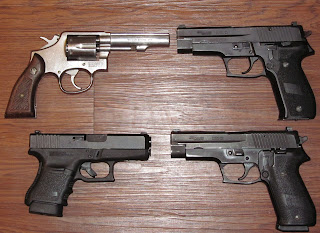
Overall, I have found police trade ins to be an excellent value, and a way to buy pistols that I may not be otherwise able to afford. I can tolerate some finish wear and needing to replace a couple of springs, in able to get a great functioning and shooting firearm. And here is a picture of some of my favorite police trade in pistols: The top row is a Smith and Wesson Model 64 revolver, and the aforementioned Sig 226 9mm (you can see some finish wear on the muzzle end of the slide) and the bottom row is a Glock 36, and Sig 220. Notice that with the Glock finish, and the stainless steel on the Model 64 the finish looks fine.
But the truth of it is, that a pistol from a reputable manufacturer is going to be better made, and have better features. It will be constructed of better materials, and probably has a good warranty from the maker (you can verify this before buying by seeing what the manufacturer's warranty policy is). And a firearm from a reputable maker will last a lifetime of shooting for the average user. So, if I have a $400 handgun, that I use for 40 years, it works out to under a dollar a month of use. Which is why saving up and buying a quality handgun is always a good idea.
Now, a lot of the more common and popular handgun brands cost five hundred dollars or more, with several thousand dollars being possible. And that is a lot of money to spend on a handgun, I understand that. So, I have found a way to get quality made firearms at a much lower cost than retail for a new gun. Within the used gun market, are what are known as "police trade in guns," and these are often some of the best buys you can make.
When a police department decides to switch out firearms platforms, often their old duty guns get sold to dealers at low cost. This means that these batches of police trade ins are comprised of firearms that have been in common use with law enforcement in the past decade. This isn't just limited to pistols either, I have also seen police trade in batches of Ruger Mini-14's, and Remington 870 Police shotguns. I have also seen most of the sidearms that people commonly want for defensive purposes, like pistols from Sig Sauer, Glock Smith and Wesson semi-automatics and revolvers, Beretta and Kahr. These firearms often sell cheaper than a normal used gun of the same model, because the dealers buy them in bulk. Often they sell for half or two-thirds of the new price. For example, in the past I picked up a $1,000 Sig 226 in 9mm for five hundred dollars. A lot of these pistols also have night sights on them, because they were used by police departments, and while they aren't as bright as new night sights, they are often still usable.
There are a few downsides to the police trade in firearms. First of all, is that they generally have some finish wear. These pistols have generally been carried a lot, and shot very little (usually only for yearly qualifications), so they have holster wear. I don't really have a problem with these, because my firearms are tools, and they are going to acquire holster wear from use. The other main problem is that you don't really get choices on what options you get. If you go on Sig Sauer's website, you will see that they have a lot of different trigger styles, and upgrade packages for the 226. The 226 that I bought was the normal variant, with their traditional DA/SA trigger. So, if you want a particular upgraded model, police trade ins probably aren't for you. You also don't know how many rounds the pistol has had through it, and every so often springs do need replaced in pistols, especially your recoil spring. But with the money you save, you can spend a few dollars for a new recoil spring. Another issue is that usually larger dealers buy up the batches of trade ins, so you either need to live close to them, or pay a transfer fee to your local gun store.
Overall, I have found police trade ins to be an excellent value, and a way to buy pistols that I may not be otherwise able to afford. I can tolerate some finish wear and needing to replace a couple of springs, in able to get a great functioning and shooting firearm. And here is a picture of some of my favorite police trade in pistols: The top row is a Smith and Wesson Model 64 revolver, and the aforementioned Sig 226 9mm (you can see some finish wear on the muzzle end of the slide) and the bottom row is a Glock 36, and Sig 220. Notice that with the Glock finish, and the stainless steel on the Model 64 the finish looks fine.

Monday, June 25, 2012
Weapon mounted vs. handheld light sources
As a civilian, it is very important to be able to identify a threat before you engage your target. The majority of civilian defensive conditions occur in low-light or night time settings, so having some sort of illumination device handy is important.
Night sights and lasers can both be great additions to a defensive sidearm. Night sights contain a small amount of a substance called Tritium in them, which glows in the dark. That allows you to obtain proper sight alignment, even in the dark. Another added side effect is that if you have them on your nightstand gun, you can use them as a reference point in the middle of the night to know where the pistol is, without the need to fumble around blindly. The main downside is cost, but usually for $100-150 you can get a set installed on your pistol, and they also make rifle front sight posts and shotgun beads with tritium. The other downside is that they don't last forever. Tritium has a relatively short half-life, and so the sights dim over time, and need replaced after 10 or 15 years or so.
Lasers can also have definite advantages for defensive use. They make a very visible aiming point on your target, and you don't really need to worry about sights. In target range practice, you should work on mastering aiming with sights before you rely on the laser, but, in at the average ranges in a defense scenario, a laser is a definite advantage. They also have their downsides. They are more expensive than night sights, and run off batteries, which can fail when you need them most (which is why you should know how to use your iron sights too). Also, due to the trajectory at which a bullet travels after it leaves the barrel, which is some variation of a parabolic arch, the laser is only truly on target at a set distance. Aside from that set distance, some sort of Kentucky windage is needed.
Now that I have covered some basics on those sighting aids, back to illumination sources. You have two main options, a weapon-mounted light (WML), or a handheld flashlight, both have advantages and disadvantages, which I will cover. I am not going to attempt to convey proper methods for using/holding flashlights in this post, that is something best covered in actual training.
The handheld flashlight is the simpler of the two. Some traits that you want to look for if you are going to buy a flashlight for defensive use are a momentary switch, something durable, with a long battery life. Surefire, Streamlight and Fenix all make suitable flashlights. You want something small and light enough to carry and conceal, but not so small that it isn't bright enough to use. For reference, I often carry a Surefire 6P LED, or a G2. I prefer flashlights with tail end on/off switches, I find them easier to manipulate properly. I like them to have a temporary on/off, and as well as a constant on/off capability. That way I can use light sparingly if needed, or leave it on without my hand cramping up from holding it too long. The main disadvantage of a handheld light is that you need to modify your grip on whatever firearm you are using, be it a handgun or a long-gun. It is also one more thing that you need to carry and control. But it can also serve as an improvised weapon in your off-hand, for using hammer-fist strikes or a similar technique at close range. Also, with the brightness of modern hand held flashlights, you can use them to temporarily blind/disorient the threat.
WML's seem to be more en vogue these days, sticking with the current "tacti-cool" craze in the firearms industry. The advantage to them is that they let you keep both hands on your firearm for a more solid grip, if they are set up properly, you don't even need to modify your grip. And it keeps everything contained in one package, there is nothing additional you need to grab. One downside is that if you mount a WML on a pistol, it adds bulk and weight onto the sidearm. If you are carrying the pistol concealed, that is a big consideration. Make sure that you function test your sidearm with the light on, it order to make sure that it operates properly with the different balance and weight distribution. You also need to get a specially made holster in order to fit the combo, because you aren't going to have time to put the light on the gun in a lethal situation. This adds cost, as well as makes concealment more difficult. For long-guns, WML's make more sense to me, mounted far forward to reduce barrel shadow, and in a position where I can either operate the tail switch with my forward hand, or with a pressure switch running back to where my hand normally is, or both. Pressure switches can be great, but they can fail, the wiring can go bad, and they have a higher likelihood of getting bumped accidentally when you don't want them to. However, either on a pistol or long-gun, you need to make sure you buy a quality light that is capable of absorbing repeated recoil without damaging the bulb and internals. This is especially true for a light you are going to mount on a gun with a high amount of recoil, like a 12 gauge shotgun.
But, the major difference between the two, and biggest disadvantage of the WML is this: you have to point your gun at something in order to illuminate it. If that thing is a threat, then that is okay. But if that thing isn't a threat, then it is a major issue to muzzle someone or something with a loaded firearm. A cardinal rule of gun safety is "don't point the gun at anything you aren't willing to destroy." And if you are searching into dark corners with a WML, you are almost certainly violating that rule. A handheld light can be used independently of the firearm, you can scan the whole area while keeping the gun pointed in a safe direction. You can illuminate an area in a non-threat scenario, without pulling out your sidearm. Or by using proper technique, you can use a handheld light to illuminate the area your muzzle is pointing.
I do believe that both systems can serve an important role, but you need to be cognizant of which one is proper for your situation. When I am out and about, I usually have some sort of handheld light on my person, and use it fairly often for simply illuminating something. But, at home, my defensive long-guns have WML's on them, which I have trained to use during my time in the Marines, but I also keep a handheld light handy, and which one I will use depends on the situation.
Being able to identify your target, and also being able to control your muzzle are both very important in a high stress threat situation. I think that having some sort of light source handy, at least during low-light or night time is a good idea, for more reasons than just defensive use. I hope this has been informative, as always, if anyone has questions or comments, please feel free to contact me. Shoot straight.
Night sights and lasers can both be great additions to a defensive sidearm. Night sights contain a small amount of a substance called Tritium in them, which glows in the dark. That allows you to obtain proper sight alignment, even in the dark. Another added side effect is that if you have them on your nightstand gun, you can use them as a reference point in the middle of the night to know where the pistol is, without the need to fumble around blindly. The main downside is cost, but usually for $100-150 you can get a set installed on your pistol, and they also make rifle front sight posts and shotgun beads with tritium. The other downside is that they don't last forever. Tritium has a relatively short half-life, and so the sights dim over time, and need replaced after 10 or 15 years or so.
Lasers can also have definite advantages for defensive use. They make a very visible aiming point on your target, and you don't really need to worry about sights. In target range practice, you should work on mastering aiming with sights before you rely on the laser, but, in at the average ranges in a defense scenario, a laser is a definite advantage. They also have their downsides. They are more expensive than night sights, and run off batteries, which can fail when you need them most (which is why you should know how to use your iron sights too). Also, due to the trajectory at which a bullet travels after it leaves the barrel, which is some variation of a parabolic arch, the laser is only truly on target at a set distance. Aside from that set distance, some sort of Kentucky windage is needed.
Now that I have covered some basics on those sighting aids, back to illumination sources. You have two main options, a weapon-mounted light (WML), or a handheld flashlight, both have advantages and disadvantages, which I will cover. I am not going to attempt to convey proper methods for using/holding flashlights in this post, that is something best covered in actual training.
The handheld flashlight is the simpler of the two. Some traits that you want to look for if you are going to buy a flashlight for defensive use are a momentary switch, something durable, with a long battery life. Surefire, Streamlight and Fenix all make suitable flashlights. You want something small and light enough to carry and conceal, but not so small that it isn't bright enough to use. For reference, I often carry a Surefire 6P LED, or a G2. I prefer flashlights with tail end on/off switches, I find them easier to manipulate properly. I like them to have a temporary on/off, and as well as a constant on/off capability. That way I can use light sparingly if needed, or leave it on without my hand cramping up from holding it too long. The main disadvantage of a handheld light is that you need to modify your grip on whatever firearm you are using, be it a handgun or a long-gun. It is also one more thing that you need to carry and control. But it can also serve as an improvised weapon in your off-hand, for using hammer-fist strikes or a similar technique at close range. Also, with the brightness of modern hand held flashlights, you can use them to temporarily blind/disorient the threat.
WML's seem to be more en vogue these days, sticking with the current "tacti-cool" craze in the firearms industry. The advantage to them is that they let you keep both hands on your firearm for a more solid grip, if they are set up properly, you don't even need to modify your grip. And it keeps everything contained in one package, there is nothing additional you need to grab. One downside is that if you mount a WML on a pistol, it adds bulk and weight onto the sidearm. If you are carrying the pistol concealed, that is a big consideration. Make sure that you function test your sidearm with the light on, it order to make sure that it operates properly with the different balance and weight distribution. You also need to get a specially made holster in order to fit the combo, because you aren't going to have time to put the light on the gun in a lethal situation. This adds cost, as well as makes concealment more difficult. For long-guns, WML's make more sense to me, mounted far forward to reduce barrel shadow, and in a position where I can either operate the tail switch with my forward hand, or with a pressure switch running back to where my hand normally is, or both. Pressure switches can be great, but they can fail, the wiring can go bad, and they have a higher likelihood of getting bumped accidentally when you don't want them to. However, either on a pistol or long-gun, you need to make sure you buy a quality light that is capable of absorbing repeated recoil without damaging the bulb and internals. This is especially true for a light you are going to mount on a gun with a high amount of recoil, like a 12 gauge shotgun.
But, the major difference between the two, and biggest disadvantage of the WML is this: you have to point your gun at something in order to illuminate it. If that thing is a threat, then that is okay. But if that thing isn't a threat, then it is a major issue to muzzle someone or something with a loaded firearm. A cardinal rule of gun safety is "don't point the gun at anything you aren't willing to destroy." And if you are searching into dark corners with a WML, you are almost certainly violating that rule. A handheld light can be used independently of the firearm, you can scan the whole area while keeping the gun pointed in a safe direction. You can illuminate an area in a non-threat scenario, without pulling out your sidearm. Or by using proper technique, you can use a handheld light to illuminate the area your muzzle is pointing.
I do believe that both systems can serve an important role, but you need to be cognizant of which one is proper for your situation. When I am out and about, I usually have some sort of handheld light on my person, and use it fairly often for simply illuminating something. But, at home, my defensive long-guns have WML's on them, which I have trained to use during my time in the Marines, but I also keep a handheld light handy, and which one I will use depends on the situation.
Being able to identify your target, and also being able to control your muzzle are both very important in a high stress threat situation. I think that having some sort of light source handy, at least during low-light or night time is a good idea, for more reasons than just defensive use. I hope this has been informative, as always, if anyone has questions or comments, please feel free to contact me. Shoot straight.
Monday, June 18, 2012
Why Do I Need Extra Ammo?
I hear this question on occasion from students: "Why do I need to carry spare ammo? I'm a great shot, and I don't go to bad parts of town, that just seems like too much trouble." So, in this post I am going to try to shed some light on why I believe it is prudent to carry spare ammunition for your defensive sidearm.
The first reason is that you really do not want to run out of ammunition in a gun fight. That is one of the worst things that can happen. If you are already developing a defensive mindset, and becoming aware of your surroundings, and carrying a pistol for defense, concealing an extra magazine or two really isn't any harder. Especially if you are carrying a snub nosed revolver, or a sub-compact semi-auto that has a capacity of 6 or more, this applies. You may be able to put all of your shots in the 10 ring at a static range, and that shows you have the fundamentals of shooting down very well. But life gets a lot different when there is someone shooting at you, with bullets cracking over your head, and your body gives you a massive dose of adrenaline and other chemicals into your blood stream. You get tunnel vision, you lose fine motor skills, you focus on odd aspects of what is going on, your heart-rate increases, you get out of breath easily. You should be moving, and your target is likely moving. That makes it significantly harder to be able to put your bullets where you want them. Additionally, you don't know how many threats you may face, it could be a sole attacker, but criminals rarely work alone. And there is no guarantee that one or two rounds will stop each threat, and you should shoot until the threat is stopped.
This is one of the reasons that you should push yourself in training, and take yourself out of your comfort zone. If your range lets you practice draws, shooting on the move, magazine reloads and malfunction drills, take advantage of that. Don't just stay static on the range and punch holes in paper. That way you can learn how to do complex things while under stress.
So, maybe you have a high-capacity semi-automatic handgun you carry, and you read that last paragraph thinking "If 17 rounds doesn't get me out of the situation, nothing will." Well, that is your opinion, however, with any box-magazine fed gun, the magazine is usually the weakest link in the cycle of operation. Magazines are mechanical and work based on springs, which means they can fail. And with a non-working magazine, your semi-automatic just turned into a single-shot pistol. The majority of malfunctions in a semi-automatic are magazine related. Or what if your magazine release latch somehow got pushed in during all the stress, and your magazine goes flying onto the deck? It is a lot easier to grab a new magazine from your waistline than scrambling in the mud for it. Or if the base-plate got knocked off of your magazine while grappling on the ground, and the spring, follower and bullets are now in the mud too? If for some reason your magazine or ammunition has failed, often the best solution is to replace it. So, having a spare magazine or two to reload with is an excellent idea.
So, maybe after that paragraph, you are thinking "I carry a revolver, so that doesn't apply to me!" In which case, refer back to the earlier paragraph, because you probably have a 5-6 round capacity. If you are in the revolver category, it is probably also a good idea to carry your spare rounds in some sort of device made to hold them. There are speed loaders, speed strips, and moon clips, and you need to find what works best for you, but all of them make the loading process much faster and easier. You don't want to be fumbling around in your pocket for loose rounds while you are reloading in a threat situation. For a revolver spare ammo is usually carried on the strong side, in order to facilitate a proper reload, as was taught to the military and police for decades.
For semi-automatic carriers, usually just taking a magazine and throwing it in your pocket is not ideal. The reason for that is that it means the magazine will not be in a consistent position when you grab it. Having your magazines in a consistent position will help make your reloads a lot faster. That way you can build solid muscle memory and know what your body needs to do in order to reload quickly. So, your magazines should be in a magazine carrier, preferably on your weak side, to facilitate a smooth reload. I usually buy double magazine pouches, and carry two spare magazines. That is a personal choice, and I decide if I am going to conceal one magazine, I can conceal two. But there are single magazine carriers available. An additional advantage of having the spare magazines on the weak side of the waistline is that it helps balance out the weight I am carrying, and actually makes it more comfortable for me to carry a full sized pistol. With just the pistol on my belt in a holster, after half a day or so, sometimes it gets uncomfortable, with the magazines opposite the pistol, I don't notice the weight all day.
I believe it is prudent for someone who takes defense seriously to carry at least one reload for their firearm. I don't think that as a civilian I need to carry the hundreds of rounds that I used to carry as a Marine infantryman in combat zones, however, a spare magazine or two still makes a lot of sense. If you have any comments or questions about this, please feel free to contact me or leave a comment.
EDIT: As a response to a comment below, questioning the viability of situations that would require more than 8 rounds, here is an addendum:
Steve,
Thank you for taking the time to read and respond.
Maybe it isn't the far fetched scenario of having to stare down 9 guys like Snake. Maybe it is one guy that is high on some strong drugs, like PCP, or a determined attacker.
The man who was supposedly on bath salts and eating another man's face was shot 4 times before the threat ended. And since a police officer shot him, it is fairly safe to assume it was with a service caliber weapon and modern hollowpoint ammo.
In the 1986 Miami FBI shootout, one suspect was shot 6 times, the other 12. That event is what prompted the FBI to go to more powerful, higher capacity pistols than the .38 revolvers most of their agents carried.
David Brown Jr, in Dallas Texas, killed one police officer and a bystander, before he was shot 9 times and killed by another officer. He was high on PCP. Once again, multiple rounds from a service caliber and defensive ammo.
I am aware that all of those examples are police shootings, and maybe you think they don't apply because of it. But, for information about performance of modern defensive ammo, that is one of the best sources. But one, or two determined attackers, or attackers high on something that makes them feel no pain, can easily take multiple shots before the threat is over.
Shot placement is key, but it is very hard to put a shot in the right place while moving away from the threat and towards cover, and with all that physiological stuff I mentioned before going on. The areas of the human body that need to be shot for instant incapacitation are rather small.
Some states do have a duty to retreat, and those requirements differ from state to state. And since I am not a lawyer and can not give legal advice, I am not going to comment on what the law may or may not say. Lethal threat scenarios are too dynamic and fluid to make a judgement call on something like that unless you have all the information.
But, I think that assuming the 6,7,8, rounds in your pistol is enough may be wishful thinking with the behavior some drugged up criminals exhibit.
I do agree that other sorts of training are very valuable as well. As a trainer, I am constantly looking for ways to improve my own skills. "If the only tool you have is a hammer, pretty soon everything starts to look like a nail" applies here. Beyond all the firearms disciplines, firearms retention, open hand skills, defensive knife skills, and improvised weapon skills are all excellent additions. And of course, developing an acute defensive mindset is the more important defensive training of all.
Thank you for your response. If you like what you read in my blog, feel free to share it with your friends. Hopefully this helped clear up any issues you had. Take care.
The first reason is that you really do not want to run out of ammunition in a gun fight. That is one of the worst things that can happen. If you are already developing a defensive mindset, and becoming aware of your surroundings, and carrying a pistol for defense, concealing an extra magazine or two really isn't any harder. Especially if you are carrying a snub nosed revolver, or a sub-compact semi-auto that has a capacity of 6 or more, this applies. You may be able to put all of your shots in the 10 ring at a static range, and that shows you have the fundamentals of shooting down very well. But life gets a lot different when there is someone shooting at you, with bullets cracking over your head, and your body gives you a massive dose of adrenaline and other chemicals into your blood stream. You get tunnel vision, you lose fine motor skills, you focus on odd aspects of what is going on, your heart-rate increases, you get out of breath easily. You should be moving, and your target is likely moving. That makes it significantly harder to be able to put your bullets where you want them. Additionally, you don't know how many threats you may face, it could be a sole attacker, but criminals rarely work alone. And there is no guarantee that one or two rounds will stop each threat, and you should shoot until the threat is stopped.
This is one of the reasons that you should push yourself in training, and take yourself out of your comfort zone. If your range lets you practice draws, shooting on the move, magazine reloads and malfunction drills, take advantage of that. Don't just stay static on the range and punch holes in paper. That way you can learn how to do complex things while under stress.
So, maybe you have a high-capacity semi-automatic handgun you carry, and you read that last paragraph thinking "If 17 rounds doesn't get me out of the situation, nothing will." Well, that is your opinion, however, with any box-magazine fed gun, the magazine is usually the weakest link in the cycle of operation. Magazines are mechanical and work based on springs, which means they can fail. And with a non-working magazine, your semi-automatic just turned into a single-shot pistol. The majority of malfunctions in a semi-automatic are magazine related. Or what if your magazine release latch somehow got pushed in during all the stress, and your magazine goes flying onto the deck? It is a lot easier to grab a new magazine from your waistline than scrambling in the mud for it. Or if the base-plate got knocked off of your magazine while grappling on the ground, and the spring, follower and bullets are now in the mud too? If for some reason your magazine or ammunition has failed, often the best solution is to replace it. So, having a spare magazine or two to reload with is an excellent idea.
So, maybe after that paragraph, you are thinking "I carry a revolver, so that doesn't apply to me!" In which case, refer back to the earlier paragraph, because you probably have a 5-6 round capacity. If you are in the revolver category, it is probably also a good idea to carry your spare rounds in some sort of device made to hold them. There are speed loaders, speed strips, and moon clips, and you need to find what works best for you, but all of them make the loading process much faster and easier. You don't want to be fumbling around in your pocket for loose rounds while you are reloading in a threat situation. For a revolver spare ammo is usually carried on the strong side, in order to facilitate a proper reload, as was taught to the military and police for decades.
For semi-automatic carriers, usually just taking a magazine and throwing it in your pocket is not ideal. The reason for that is that it means the magazine will not be in a consistent position when you grab it. Having your magazines in a consistent position will help make your reloads a lot faster. That way you can build solid muscle memory and know what your body needs to do in order to reload quickly. So, your magazines should be in a magazine carrier, preferably on your weak side, to facilitate a smooth reload. I usually buy double magazine pouches, and carry two spare magazines. That is a personal choice, and I decide if I am going to conceal one magazine, I can conceal two. But there are single magazine carriers available. An additional advantage of having the spare magazines on the weak side of the waistline is that it helps balance out the weight I am carrying, and actually makes it more comfortable for me to carry a full sized pistol. With just the pistol on my belt in a holster, after half a day or so, sometimes it gets uncomfortable, with the magazines opposite the pistol, I don't notice the weight all day.
I believe it is prudent for someone who takes defense seriously to carry at least one reload for their firearm. I don't think that as a civilian I need to carry the hundreds of rounds that I used to carry as a Marine infantryman in combat zones, however, a spare magazine or two still makes a lot of sense. If you have any comments or questions about this, please feel free to contact me or leave a comment.
EDIT: As a response to a comment below, questioning the viability of situations that would require more than 8 rounds, here is an addendum:
Steve,
Thank you for taking the time to read and respond.
Maybe it isn't the far fetched scenario of having to stare down 9 guys like Snake. Maybe it is one guy that is high on some strong drugs, like PCP, or a determined attacker.
The man who was supposedly on bath salts and eating another man's face was shot 4 times before the threat ended. And since a police officer shot him, it is fairly safe to assume it was with a service caliber weapon and modern hollowpoint ammo.
In the 1986 Miami FBI shootout, one suspect was shot 6 times, the other 12. That event is what prompted the FBI to go to more powerful, higher capacity pistols than the .38 revolvers most of their agents carried.
David Brown Jr, in Dallas Texas, killed one police officer and a bystander, before he was shot 9 times and killed by another officer. He was high on PCP. Once again, multiple rounds from a service caliber and defensive ammo.
I am aware that all of those examples are police shootings, and maybe you think they don't apply because of it. But, for information about performance of modern defensive ammo, that is one of the best sources. But one, or two determined attackers, or attackers high on something that makes them feel no pain, can easily take multiple shots before the threat is over.
Shot placement is key, but it is very hard to put a shot in the right place while moving away from the threat and towards cover, and with all that physiological stuff I mentioned before going on. The areas of the human body that need to be shot for instant incapacitation are rather small.
Some states do have a duty to retreat, and those requirements differ from state to state. And since I am not a lawyer and can not give legal advice, I am not going to comment on what the law may or may not say. Lethal threat scenarios are too dynamic and fluid to make a judgement call on something like that unless you have all the information.
But, I think that assuming the 6,7,8, rounds in your pistol is enough may be wishful thinking with the behavior some drugged up criminals exhibit.
I do agree that other sorts of training are very valuable as well. As a trainer, I am constantly looking for ways to improve my own skills. "If the only tool you have is a hammer, pretty soon everything starts to look like a nail" applies here. Beyond all the firearms disciplines, firearms retention, open hand skills, defensive knife skills, and improvised weapon skills are all excellent additions. And of course, developing an acute defensive mindset is the more important defensive training of all.
Thank you for your response. If you like what you read in my blog, feel free to share it with your friends. Hopefully this helped clear up any issues you had. Take care.
Sunday, June 10, 2012
Why Waistline Carry Makes the Most Sense to Me
While staying on the topic of the last thread, which was why it is important to have a complete concealed carry rig, as opposed to just a holster, today I am going to discuss why waistline or belt carry, makes the most sense to me. Belt carry is the most popular way to carry a concealed handgun, and for good reason. It keeps the firearm in place, is comfortable with the right rig, conceals well for most, and offers a rather fast draw time. With a proper rig, you can also conceal a full sized handgun without too much of a problem, provided you are wearing appropriate clothing. If keeps the handgun easily accessible in case you need it, and doesn't require you to cross over any of your own body parts, or flag, with the muzzle of a loaded firearm. But it is not the only way to carry a firearm, some of the other options include pocket carry, shoulder holsters, ankle carry, and I will explain some of the pros and cons of each of those.
Pocket carry is the only way that I carry a pistol aside from waistline carry, and is a viable option for the most part. Now, when I am talking about pocket carry, I don't mean just take a pistol and jam it in your pocket with your keys and cell phone. You still should be using a holster for pocket carry, and a number of manufacturers make pocket holsters. I am partial to the Desantis Nemesis for this role, as it stays in the pocket during the draw. A pocket holster provides two functions, first, it protects the trigger to make sure no foreign objects can interact with it, and second, it helps break up the outline of the pistol. If you are wearing skin tight jeans or pants made of very thin material. pocket carry probably won't work for you, because the pistol will print (be visible through the fabric). Also, if you are going to pocket carry, the pistol should be the only thing in that pocket, put your keys, cell phone, knife, wallet or whatever else goes in your pockets somewhere else.
But, pocket carry allows you to still have a rather fast draw time, and you can have your hand on your pistol without alerting anyone (something you can not do easily with belt carry). And with the right pants it conceals rather well, and can be carried in styles of dress where belt carry is not possible, like business casual. The biggest drawback of pocket carry for me is that it really limits what firearms you can carry. When I pocket carry, it is with a S&W 638 snub nosed revolver, whereas my normal carry pistol is currently a Sig Sauer 220. So, I am carrying a pistol that is harder to shoot because of the shorter grip and sight radius, with less rounds, a slower reload, and a less powerful caliber. But, the gun in your hand when you need it is better than the one at home in the safe, so, if due to how I need to dress I can't carry my preferred gun, pocket carry with a small revolver or semi-auto beats being unarmed. So pocket carry is an option, just keep in mind most pants pockets won't hold a full sized pistol, so you sacrifice in things like magazine capacity and ease of shooting for your carry pistol.
Next is shoulder holster carry, which honestly I have never really had work for me. Some people say they get it to work, and in my experience, that is usually tall skinny people. One of the few advantages of shoulder holsters is that they let you carry even larger pistols than belt carry, especially with a vertical shoulder holster. If you want to carry a Smith and Wesson N or X frame, this is the way to do it (although, those are more appropriate for big game hunting and would be open carried in my opinion). But usually unless you have decently thick fabric in your cover garment, the harness prints through. I also don't like that the holster is not stable while you are carrying, it can move around, and I like my holster to be consistently in the same spot.
My two biggest issues with shoulder holster carry is that first, you need to reach across your body to draw. Now, if you spend a majority of time seated, like working as a driver, a cross draw belt holster or shoulder holster might make sense. But, if someone is already at bad breath distance from you, and you need to reach your hand across your body to draw your pistol, that is a rather simple move for the bad guy to block. And what if he has already knocked you down and is literally on top of you? He can just pin your arm down with a leg or hand, and you can't draw. In that instance, it is easier for him to draw your pistol. But, my biggest issue with shoulder holsters is that you pretty much have to flag a part of your own body with the muzzle of a loaded handgun during the draw. Usually that part of your body is your off-side arm. I am a firm believer in the firearms safety rules, including to never point a weapon at anything you don't want to shoot. I do not want to shoot myself in the arm, or any other body part. So during a high stress lethal situation, I don't want to have to flag any part of my body with my loaded firearm while a chemical cocktail inside my own body is doing things like decreasing my fine motor skills. So, for me, shoulder holster carry is not an option. It looks really cool in the movies, but doesn't seem really practical for real life.
Next up is ankle carry, which also seems really cool in the movies. But is probably the worst of the "mainstream" ways to carry a pistol. First of all, it isn't very comfortable a lot of the time, and can make you feel unbalanced as you walk. Like pocket carry it basically restricts you to small semi-automatics or revolvers, meaning your pistol is going to be harder to shoot, and have a smaller capacity. But the real downfall of ankle carry is the draw method. If you are standing and need to draw, you have to expose the top of your head to the threat, which isn't something I ever want to do, while simultaneously moving your head closer to the bad guy. You also are compromising your balance if you try to bring your leg up to you, which would make it much easier for someone to knock you over, and gain a dominant position where even unarmed they could do significant damage. If you are sitting down the draw is a little bit better balance wise, but you still may have to expose the top of your head. And if you are already on the ground grappling with someone, you can pretty much forget making it to your pistol. Ankle carry can also be hard to conceal, because if your pants leg rides up during movement, you are no longer concealing your pistol. So, ankle carry is not a method that I would recommend.
In my opinion, waistline carry, either inside the waistband, or outside the waistband is still the best option, which is probably why it has been the preferred method since pistols began to be made and be carried a couple hundred years ago. It is the best balance between conceal-ability with a service sized handgun, comfort, and accessibility and speed during the draw. I know that there are several other methods of carry that people have come up with, but for now I chose to stick with the methods outlined above. If anyone has questions about any other specific carry method, feel free to contact me, and I will answer your questions. Thanks for reading, I hope everyone learned something this post, or at least read something that makes them think about concealing differently.
Pocket carry is the only way that I carry a pistol aside from waistline carry, and is a viable option for the most part. Now, when I am talking about pocket carry, I don't mean just take a pistol and jam it in your pocket with your keys and cell phone. You still should be using a holster for pocket carry, and a number of manufacturers make pocket holsters. I am partial to the Desantis Nemesis for this role, as it stays in the pocket during the draw. A pocket holster provides two functions, first, it protects the trigger to make sure no foreign objects can interact with it, and second, it helps break up the outline of the pistol. If you are wearing skin tight jeans or pants made of very thin material. pocket carry probably won't work for you, because the pistol will print (be visible through the fabric). Also, if you are going to pocket carry, the pistol should be the only thing in that pocket, put your keys, cell phone, knife, wallet or whatever else goes in your pockets somewhere else.
But, pocket carry allows you to still have a rather fast draw time, and you can have your hand on your pistol without alerting anyone (something you can not do easily with belt carry). And with the right pants it conceals rather well, and can be carried in styles of dress where belt carry is not possible, like business casual. The biggest drawback of pocket carry for me is that it really limits what firearms you can carry. When I pocket carry, it is with a S&W 638 snub nosed revolver, whereas my normal carry pistol is currently a Sig Sauer 220. So, I am carrying a pistol that is harder to shoot because of the shorter grip and sight radius, with less rounds, a slower reload, and a less powerful caliber. But, the gun in your hand when you need it is better than the one at home in the safe, so, if due to how I need to dress I can't carry my preferred gun, pocket carry with a small revolver or semi-auto beats being unarmed. So pocket carry is an option, just keep in mind most pants pockets won't hold a full sized pistol, so you sacrifice in things like magazine capacity and ease of shooting for your carry pistol.
Next is shoulder holster carry, which honestly I have never really had work for me. Some people say they get it to work, and in my experience, that is usually tall skinny people. One of the few advantages of shoulder holsters is that they let you carry even larger pistols than belt carry, especially with a vertical shoulder holster. If you want to carry a Smith and Wesson N or X frame, this is the way to do it (although, those are more appropriate for big game hunting and would be open carried in my opinion). But usually unless you have decently thick fabric in your cover garment, the harness prints through. I also don't like that the holster is not stable while you are carrying, it can move around, and I like my holster to be consistently in the same spot.
My two biggest issues with shoulder holster carry is that first, you need to reach across your body to draw. Now, if you spend a majority of time seated, like working as a driver, a cross draw belt holster or shoulder holster might make sense. But, if someone is already at bad breath distance from you, and you need to reach your hand across your body to draw your pistol, that is a rather simple move for the bad guy to block. And what if he has already knocked you down and is literally on top of you? He can just pin your arm down with a leg or hand, and you can't draw. In that instance, it is easier for him to draw your pistol. But, my biggest issue with shoulder holsters is that you pretty much have to flag a part of your own body with the muzzle of a loaded handgun during the draw. Usually that part of your body is your off-side arm. I am a firm believer in the firearms safety rules, including to never point a weapon at anything you don't want to shoot. I do not want to shoot myself in the arm, or any other body part. So during a high stress lethal situation, I don't want to have to flag any part of my body with my loaded firearm while a chemical cocktail inside my own body is doing things like decreasing my fine motor skills. So, for me, shoulder holster carry is not an option. It looks really cool in the movies, but doesn't seem really practical for real life.
Next up is ankle carry, which also seems really cool in the movies. But is probably the worst of the "mainstream" ways to carry a pistol. First of all, it isn't very comfortable a lot of the time, and can make you feel unbalanced as you walk. Like pocket carry it basically restricts you to small semi-automatics or revolvers, meaning your pistol is going to be harder to shoot, and have a smaller capacity. But the real downfall of ankle carry is the draw method. If you are standing and need to draw, you have to expose the top of your head to the threat, which isn't something I ever want to do, while simultaneously moving your head closer to the bad guy. You also are compromising your balance if you try to bring your leg up to you, which would make it much easier for someone to knock you over, and gain a dominant position where even unarmed they could do significant damage. If you are sitting down the draw is a little bit better balance wise, but you still may have to expose the top of your head. And if you are already on the ground grappling with someone, you can pretty much forget making it to your pistol. Ankle carry can also be hard to conceal, because if your pants leg rides up during movement, you are no longer concealing your pistol. So, ankle carry is not a method that I would recommend.
In my opinion, waistline carry, either inside the waistband, or outside the waistband is still the best option, which is probably why it has been the preferred method since pistols began to be made and be carried a couple hundred years ago. It is the best balance between conceal-ability with a service sized handgun, comfort, and accessibility and speed during the draw. I know that there are several other methods of carry that people have come up with, but for now I chose to stick with the methods outlined above. If anyone has questions about any other specific carry method, feel free to contact me, and I will answer your questions. Thanks for reading, I hope everyone learned something this post, or at least read something that makes them think about concealing differently.
Sunday, June 3, 2012
More Than Just a Holster
The last few post I have written were more about the "software" side of things, dealing with a defensive mindset and and associated topics. This one is going to be a change of pace, and go back to talking about the hardware and gear side. Holsters and carry rigs are pieces of gear that often do not get the attention that they deserve, and without the right gear, it can be very difficult to successfully conceal a handgun. I conceal full sized service handguns (like a full sized 1911 or Sig 220) on a regular basis, and am able to do so because I have put the time and effort into finding the concealed carry set-up that works for me, and the money into buying it. I am going to focus for this post on waistline, or belt carry, as it is how most people successfully conceal handguns for defense, and it has a lot of advantages. In a future post I will cover more ways to carry, like shoulder holsters, ankle and pocket carry.
A lot of people go buy their gun, and get their permit, and then use the cheapest holster they can find for their gun. This is often either a Kydex belt slide that a lot of makers now ship with the gun, or a nylon one size fits many holster from the local gun store. To me this is the equivalent of buying a high end sports car, and then putting the cheapest discount brand of tires you can find on it. Will they do they job, maybe, but, you can probably spend a little more money, and get much better performance out of the product.
The holster is actually, in my opinion, not the most important part of a carry rig. It is tied in importance with a good, purpose made gun-belt. By gun-belt I don't necessarily mean a gunslinger rig for a six shooter from an old western, or even a police style duty belt. But, there are companies and manufacturers out there who make belts specifically designed to hold up and distribute the weight of a handgun. You can find dressier leather ones that can be worn when needed, or more casual nylon belts that usually have a polymer stiffener in them. You can determine which works best for your fashion needs, but having a good gun belt is a must. When I started carrying I was just using whatever belts I owned from the department stores, and concealing a full sized 1911. I noticed two things, first, is that the top of the pistol had a tendency to flop outward, making it harder to conceal, and second, that I was needing a new belt every month or two, because they couldn't take the abuse. By the time I had gone through 3-4 belts, it wound up costing me more than the $60-100 a good gun-belt would have cost me, and then I had to buy the gun-belt too. Most things in the firearms world, are a front end heavy investment. But spending a little bit more upfront usually saves you money in the long run, belts and holsters are no exception.
I would rather have a good gun-belt and mediocre holster, than a good holster and mediocre belt. A good belt makes a properly designed holster more concealable. Now, holsters are still important. Your basic choices are leather, a plastic like material known as kydex, and nylon. Now, I have never found a nylon holster that works for me. They are generally cheap, generic holsters with weak attachment points that don't work particularly well for any gun. They offer no retention (the ability to keep the firearm in the holster), and make re-holstering more difficult because they collapse on themselves when empty. So, I don't really like them as an option. Between leather and kydex, it really is your choice, both have advantages and disadvantages and can be found in comparable price ranges. First of all though, over time, either one will cause finish wear on your pistol. Carry wear is a fact of life for a pistol that is going to be carried for defensive use, and something which the owner needs to be aware of.
But, taking a look at some of the advantages and disadvantages of leather. Properly made leather holsters really can be beautiful works of art. They can come with elements made from exotic animal skins, like shark or snake, and in different colors. When made and properly boned for a firearm, they can offer excellent retention. With the addition of some sort of reinforcement at the opening, one handed re-holstering is simple, and the material is flexible, so that it molds to the shape of your body for better concealment. Some of the disadvantages are that sometimes new leather holsters can squeak like a new shoe, and if not dyed properly it can bleed onto clothing. Over time the leather can lose some of its shape, although this usually takes years with a well made holster. Leather is not the most durable material in the world, and can be damaged if it gets wet. Leather holsters are still mostly made by hand, so there can be a wait of weeks or months for a holster custom made for your gun, but this wait can be worth it for a holster that you will use for years.
Kydex also offers some advantages and disadvantages. Retention with kydex is usually excellent, and there is no need to reinforce the opening, because the material is rigid to begin with. The material is very resistant to the elements, and able to take a lot of abuse before it is really damaged. It is generally more utilitarian looking than leather, a trait which some people enjoy. It doesn't really mold to the user, so sometimes there is a slightly more difficult time concealing a kydex holster. It can also be harder to break in if it is a bit too tight when it comes from the manufacturer. Kydex can usually be had a with a slightly shorter length than leather, although this depends on the maker and their demand. Also, if made improperly or too thin the kydex can be brittle. Kydex can also be rougher on your clothing with daily use, although with daily use leather or kydex can wear through fabric.
Whichever one you choose, make sure you do some research, and buy a quality made product. Some reputable holster makers also offer trial periods of up to 30 days, where if you don't like the product for some reason, you can send it back.
The last part of my carry rig is a spare magazine carrier. I will detail all the reasons why I think carrying spare ammunition is prudent in a later post. But, I will say that spare magazines on my offhand side balance out the rig better, and make it more comfortable for me to carry all day.
When you are going to be carrying a sidearm for defense, make sure you make the investment in well made gear that will help you do so effectively, and also give you years of use. Spending a little bit more up front can help you avoid the dreaded "box of holsters" that many of us who have been carrying for a while seem to accumulate. This is just a short glimpse into things to consider when you are going to start shopping for carry rigs. If you have more specific questions, feel free to contact us and we will share our knowledge with you. And if you have a question you would like to see a post on, contact me through this blog, Facebook or Twitter (@lmtactical), and I will put a post up.
A lot of people go buy their gun, and get their permit, and then use the cheapest holster they can find for their gun. This is often either a Kydex belt slide that a lot of makers now ship with the gun, or a nylon one size fits many holster from the local gun store. To me this is the equivalent of buying a high end sports car, and then putting the cheapest discount brand of tires you can find on it. Will they do they job, maybe, but, you can probably spend a little more money, and get much better performance out of the product.
The holster is actually, in my opinion, not the most important part of a carry rig. It is tied in importance with a good, purpose made gun-belt. By gun-belt I don't necessarily mean a gunslinger rig for a six shooter from an old western, or even a police style duty belt. But, there are companies and manufacturers out there who make belts specifically designed to hold up and distribute the weight of a handgun. You can find dressier leather ones that can be worn when needed, or more casual nylon belts that usually have a polymer stiffener in them. You can determine which works best for your fashion needs, but having a good gun belt is a must. When I started carrying I was just using whatever belts I owned from the department stores, and concealing a full sized 1911. I noticed two things, first, is that the top of the pistol had a tendency to flop outward, making it harder to conceal, and second, that I was needing a new belt every month or two, because they couldn't take the abuse. By the time I had gone through 3-4 belts, it wound up costing me more than the $60-100 a good gun-belt would have cost me, and then I had to buy the gun-belt too. Most things in the firearms world, are a front end heavy investment. But spending a little bit more upfront usually saves you money in the long run, belts and holsters are no exception.
I would rather have a good gun-belt and mediocre holster, than a good holster and mediocre belt. A good belt makes a properly designed holster more concealable. Now, holsters are still important. Your basic choices are leather, a plastic like material known as kydex, and nylon. Now, I have never found a nylon holster that works for me. They are generally cheap, generic holsters with weak attachment points that don't work particularly well for any gun. They offer no retention (the ability to keep the firearm in the holster), and make re-holstering more difficult because they collapse on themselves when empty. So, I don't really like them as an option. Between leather and kydex, it really is your choice, both have advantages and disadvantages and can be found in comparable price ranges. First of all though, over time, either one will cause finish wear on your pistol. Carry wear is a fact of life for a pistol that is going to be carried for defensive use, and something which the owner needs to be aware of.
But, taking a look at some of the advantages and disadvantages of leather. Properly made leather holsters really can be beautiful works of art. They can come with elements made from exotic animal skins, like shark or snake, and in different colors. When made and properly boned for a firearm, they can offer excellent retention. With the addition of some sort of reinforcement at the opening, one handed re-holstering is simple, and the material is flexible, so that it molds to the shape of your body for better concealment. Some of the disadvantages are that sometimes new leather holsters can squeak like a new shoe, and if not dyed properly it can bleed onto clothing. Over time the leather can lose some of its shape, although this usually takes years with a well made holster. Leather is not the most durable material in the world, and can be damaged if it gets wet. Leather holsters are still mostly made by hand, so there can be a wait of weeks or months for a holster custom made for your gun, but this wait can be worth it for a holster that you will use for years.
Kydex also offers some advantages and disadvantages. Retention with kydex is usually excellent, and there is no need to reinforce the opening, because the material is rigid to begin with. The material is very resistant to the elements, and able to take a lot of abuse before it is really damaged. It is generally more utilitarian looking than leather, a trait which some people enjoy. It doesn't really mold to the user, so sometimes there is a slightly more difficult time concealing a kydex holster. It can also be harder to break in if it is a bit too tight when it comes from the manufacturer. Kydex can usually be had a with a slightly shorter length than leather, although this depends on the maker and their demand. Also, if made improperly or too thin the kydex can be brittle. Kydex can also be rougher on your clothing with daily use, although with daily use leather or kydex can wear through fabric.
Whichever one you choose, make sure you do some research, and buy a quality made product. Some reputable holster makers also offer trial periods of up to 30 days, where if you don't like the product for some reason, you can send it back.
The last part of my carry rig is a spare magazine carrier. I will detail all the reasons why I think carrying spare ammunition is prudent in a later post. But, I will say that spare magazines on my offhand side balance out the rig better, and make it more comfortable for me to carry all day.
When you are going to be carrying a sidearm for defense, make sure you make the investment in well made gear that will help you do so effectively, and also give you years of use. Spending a little bit more up front can help you avoid the dreaded "box of holsters" that many of us who have been carrying for a while seem to accumulate. This is just a short glimpse into things to consider when you are going to start shopping for carry rigs. If you have more specific questions, feel free to contact us and we will share our knowledge with you. And if you have a question you would like to see a post on, contact me through this blog, Facebook or Twitter (@lmtactical), and I will put a post up.
Sunday, May 20, 2012
Have a Plan at Home
Remember back during grade school, when you would have fire drills, or maybe tornado drills if you live in an area like Ohio that is subject to tornadoes? Or maybe earthquake drills if you live along a fault line. Or any number of other drills for some sort of disaster. Looking back you make look at such drills at pointless, or maybe at the time you were just happy because a fire drill meant you had 5 less minutes of class. There was actually a very good reason for having such drills, and that is because the human mind sometimes has trouble thinking coherently when confronted with a situation outside the normal circumstances, full of unknowns.
The purpose of such drills is it helps to build a known routine that your body and mind can revert to in case of such a situation. I remember one time during grade school there were funnel clouds in the area, and when the sirens went off, every student knew exactly what to do. I can only imagine the chaos that would have occurred had we never done a tornado drill. There is a reason that military and law enforcement constantly train for a wide variety of scenarios. In the military you have months or years of training before you are deployed to a combat area, and there is a very good reason for that. Because it helps your body adapt to adverse situations.
Similarly, creating a defense plan could be a good idea for you and your family, and is something you should consider, especially if you have others living in your home. That way it will take some of the unknown out of the situation if you ever have some sort of home invasion occur. The plan can really be as simple or as detailed as you want, actually, just having a basic plan may be the best, because it is most versatile.
Now, what I am not suggesting is that you hear a bump in the night, and the try to be Rambo and clear your entire home. That is actually the last thing I would suggest, unless you have extensive house clearing training and experience, and a team of people with similar training to do it with you. Clearing a structure by yourself is an extremely dangerous, and practically impossible thing to do. There are a lot of techniques that you need to know how to do, and unless you are trained in the proper ways to do it, I would strongly, strongly suggest not to do so.
A much better plan would be preparing your home and supplies in such a manner that they aid you in the defense of your home. Make sure you have good locks on doors and windows, motion lights, possibly a security system, and other physical deterrents that will help keep out all but the most determined attacker. You can never make a structure completely impenetrable, even the mightiest castles in history fell to sieges. But, you can harden the defenses of your home, for minimal fees, that will help make your home more secure.
Aside from changes to the physical structure, have your supplies ready to go, and a plan on how to use them. If you have others, like children living with you, have a plan to consolidate all of your family members into one room. I would suggest for children, to have them stay put in a safe spot in their room, until you come get them, so family members are not running around in the dark. Find a safe way to keep a firearm and ammunition around your sleeping area, just make sure that unauthorized users can not gain access to it. Three in the morning when something awry has just woken you up is not the time to be loading magazines. If you have other adults living with you, signing up for some quality team/partner tactics training would be an excellent idea, so that both of you would be on the same page.
Have a good flashlight handy so that you can see in the dark, and learn proper techniques for how to use one in a defensive role. Have your cell phone or home phone by your bed, so that you can call the proper authorities.
Reinforce the door of whatever your "safe room" is going to be, in order to create a barrier once your entire family is in the room. One idea that I have heard as well that I like is have a spare key in the safe room attached to a new chem-light. That way, after you call the police and the dispatcher tells you that have arrived, you can activate the chem-light and throw it out the window to them, so that they can enter your home and find any possible bad guys that may be inside. If anyone else has any unique ideas that they like, I'd love to hear them.
Just as I think every home should have a plan what to do in case of natural disasters or fire (a fire plan can be as simple as setting a rally point at a place away from the house where all family members should go in case of a fire, so that everyone can be accounted for), every home should have a plan in case of a man-made attack or invasion. It doesn't need to be elaborate or flashy, but everyone living in the house should know it. A person's home is their castle, and you should be able to defend it according to the laws of the area in which you live. Making sure you know your state's "Castle Doctrine" or other home defense law is also of vital importance. But, make sure you have a plan, its better to spend some time developing the plan and never needing it, than needing a plan and not having one.
The purpose of such drills is it helps to build a known routine that your body and mind can revert to in case of such a situation. I remember one time during grade school there were funnel clouds in the area, and when the sirens went off, every student knew exactly what to do. I can only imagine the chaos that would have occurred had we never done a tornado drill. There is a reason that military and law enforcement constantly train for a wide variety of scenarios. In the military you have months or years of training before you are deployed to a combat area, and there is a very good reason for that. Because it helps your body adapt to adverse situations.
Similarly, creating a defense plan could be a good idea for you and your family, and is something you should consider, especially if you have others living in your home. That way it will take some of the unknown out of the situation if you ever have some sort of home invasion occur. The plan can really be as simple or as detailed as you want, actually, just having a basic plan may be the best, because it is most versatile.
Now, what I am not suggesting is that you hear a bump in the night, and the try to be Rambo and clear your entire home. That is actually the last thing I would suggest, unless you have extensive house clearing training and experience, and a team of people with similar training to do it with you. Clearing a structure by yourself is an extremely dangerous, and practically impossible thing to do. There are a lot of techniques that you need to know how to do, and unless you are trained in the proper ways to do it, I would strongly, strongly suggest not to do so.
A much better plan would be preparing your home and supplies in such a manner that they aid you in the defense of your home. Make sure you have good locks on doors and windows, motion lights, possibly a security system, and other physical deterrents that will help keep out all but the most determined attacker. You can never make a structure completely impenetrable, even the mightiest castles in history fell to sieges. But, you can harden the defenses of your home, for minimal fees, that will help make your home more secure.
Aside from changes to the physical structure, have your supplies ready to go, and a plan on how to use them. If you have others, like children living with you, have a plan to consolidate all of your family members into one room. I would suggest for children, to have them stay put in a safe spot in their room, until you come get them, so family members are not running around in the dark. Find a safe way to keep a firearm and ammunition around your sleeping area, just make sure that unauthorized users can not gain access to it. Three in the morning when something awry has just woken you up is not the time to be loading magazines. If you have other adults living with you, signing up for some quality team/partner tactics training would be an excellent idea, so that both of you would be on the same page.
Have a good flashlight handy so that you can see in the dark, and learn proper techniques for how to use one in a defensive role. Have your cell phone or home phone by your bed, so that you can call the proper authorities.
Reinforce the door of whatever your "safe room" is going to be, in order to create a barrier once your entire family is in the room. One idea that I have heard as well that I like is have a spare key in the safe room attached to a new chem-light. That way, after you call the police and the dispatcher tells you that have arrived, you can activate the chem-light and throw it out the window to them, so that they can enter your home and find any possible bad guys that may be inside. If anyone else has any unique ideas that they like, I'd love to hear them.
Just as I think every home should have a plan what to do in case of natural disasters or fire (a fire plan can be as simple as setting a rally point at a place away from the house where all family members should go in case of a fire, so that everyone can be accounted for), every home should have a plan in case of a man-made attack or invasion. It doesn't need to be elaborate or flashy, but everyone living in the house should know it. A person's home is their castle, and you should be able to defend it according to the laws of the area in which you live. Making sure you know your state's "Castle Doctrine" or other home defense law is also of vital importance. But, make sure you have a plan, its better to spend some time developing the plan and never needing it, than needing a plan and not having one.
Sunday, May 13, 2012
Thoughts on selecting someone else's gun for them
A question that often comes up during classes is: "What gun is the best for me?" And my answer to this question is always the same: "I don't know." I don't say that answer because I want to be mean, or because I lack knowledge of a variety of different firearms makes and models. But the truth of the matter is, a shooter has to choose their own gun be it a rifle, pistol, or shotgun. This is because there are a myriad of factors that go into what makes a firearm a good choice for a particular shooter. So, just because I may think the pistol on my hip or rifle in my hands is the greatest thing since sliced bread, it may only be that way for me, for someone else it could be a bad choice.
The over-riding factor in the decision making process should be: "What is the intended purpose of this firearm?" I am not going to use an over-under shotgun for concealed carry, and I am not going to use a pistol to shoot trap or skeet. This is probably about the only level that I will talk about others with when it comes to selecting their gun. And then I will only point them in the right direction, offering a variety of options within their price range. I may point out differences as it applies to how the firearm will fill the desired role, but once a shooter is on the right path, the rest of the selection process is up to them. Everybody is built differently, so they need to see what points and fits right for them, what feels good in their hands.
One area of the shooting world that I see the phenomenon of someone besides the shooter choosing the gun fairly often is with newer female shooters. Now, I will say up front that I think women who want to enjoy the shooting sports is a great thing, and should be encouraged. But, I think that it does a dis-service to newer female shooters, and have seen that is can be very discouraging for them, when someone buys them the gun they think they should be shooting. The general trend I see in firearms when this happens is that the resulting firearm is a sub-compact type semi-automatic or snub nosed revolver, which almost always have a short grip.
At first glance to an inexperienced shooter in a gun store, this may look like an ideal choice. It is small, so it should be easy to conceal, and is lightweight, so it is easy to hold. Many firearms makers also have variations of these models especially tailored to females, though color choices or some other method. Now the new shooter goes to a class or a range with their new firearm someone told them was the best for them, and really does not enjoy shooting the gun. They have trouble hitting the target, the trigger pull is very heavy, and the recoil is intense. So shooting their brand new gun isn't much fun for them, and they don't want to do it much, if any.
There are many reasons why this is the case, but I want to highlight a few of the main points. The first is that a short barreled pistol is not a firearm for an inexperienced shooter to learn the fundamentals of marksmanship on. The sight radius is the distance between the front and rear sights, and directly impacts practical accuracy of the firearm. Notice I said practical accuracy, which is how well a human can shoot from a normal firing position, as opposed to mechanical accuracy, where the pistol is put into a rest, and the only human interaction is the pulling of the trigger. The shorter the sight radius on a firearm, the more any errors in aiming are magnified while firing a shot. This is one of the main reasons a rifle, which may have a 20" sight radius, can generally be fired much more accurately than a pistol with a 3-5" sight radius. Also most of the "pocket pistols" have very rudimentary sights, which make getting proper sight alignment more difficult.
The short grip and lightweight of these pistols also complicate shooting them. Usually a shooter can not fit their whole hand on the grip, often only two fingers, leaving the pinky finger awkwardly placed compared to shooting a full sized pistol. It can be very hard to get a consistent grip on a small pistol, and consistency in habits is one of the keys to good marksmanship. Also, the lack of a full grip means the pistol can move around more in the hand during recoil. And these pistols generally recoil a lot, because of how lightweight they are. A .380 ACP or .38 Special can be a potent round, and when you are firing it out of a gun that weighs less than a pound, it can be downright painful. With a sub-compact 9mm, .357 Magnum, .40 S&W or .45 ACP, it can be even worse. And if a new shooter thinks a gun is painful to shoot, they aren't going to want to shoot it. So the fun experience of learning how to shoot is tarnished by a difficult, painful gun to shoot.
I will say that I have seen some newer shooters, male and female, who shoot sub-compacts very well, but in my experience they seem to be the experience instead of the rule. So, if you are a new shooter looking to buy a gun, or you know someone who you want to get a gun for, do yourself a favor, and let them pick it out. Go to a gun store, and let them handle a lot of different types, and find the one that feels good to them. Or even better, come to a class like ours where we have a wide variety of handguns from sub-compacts to full sized that our students can shoot, and find what shoots best for the individual. But, no one except the shooter can really saw what gun is going to work best for them, so they shouldn't let someone else choose their gun.
The over-riding factor in the decision making process should be: "What is the intended purpose of this firearm?" I am not going to use an over-under shotgun for concealed carry, and I am not going to use a pistol to shoot trap or skeet. This is probably about the only level that I will talk about others with when it comes to selecting their gun. And then I will only point them in the right direction, offering a variety of options within their price range. I may point out differences as it applies to how the firearm will fill the desired role, but once a shooter is on the right path, the rest of the selection process is up to them. Everybody is built differently, so they need to see what points and fits right for them, what feels good in their hands.
One area of the shooting world that I see the phenomenon of someone besides the shooter choosing the gun fairly often is with newer female shooters. Now, I will say up front that I think women who want to enjoy the shooting sports is a great thing, and should be encouraged. But, I think that it does a dis-service to newer female shooters, and have seen that is can be very discouraging for them, when someone buys them the gun they think they should be shooting. The general trend I see in firearms when this happens is that the resulting firearm is a sub-compact type semi-automatic or snub nosed revolver, which almost always have a short grip.
At first glance to an inexperienced shooter in a gun store, this may look like an ideal choice. It is small, so it should be easy to conceal, and is lightweight, so it is easy to hold. Many firearms makers also have variations of these models especially tailored to females, though color choices or some other method. Now the new shooter goes to a class or a range with their new firearm someone told them was the best for them, and really does not enjoy shooting the gun. They have trouble hitting the target, the trigger pull is very heavy, and the recoil is intense. So shooting their brand new gun isn't much fun for them, and they don't want to do it much, if any.
There are many reasons why this is the case, but I want to highlight a few of the main points. The first is that a short barreled pistol is not a firearm for an inexperienced shooter to learn the fundamentals of marksmanship on. The sight radius is the distance between the front and rear sights, and directly impacts practical accuracy of the firearm. Notice I said practical accuracy, which is how well a human can shoot from a normal firing position, as opposed to mechanical accuracy, where the pistol is put into a rest, and the only human interaction is the pulling of the trigger. The shorter the sight radius on a firearm, the more any errors in aiming are magnified while firing a shot. This is one of the main reasons a rifle, which may have a 20" sight radius, can generally be fired much more accurately than a pistol with a 3-5" sight radius. Also most of the "pocket pistols" have very rudimentary sights, which make getting proper sight alignment more difficult.
The short grip and lightweight of these pistols also complicate shooting them. Usually a shooter can not fit their whole hand on the grip, often only two fingers, leaving the pinky finger awkwardly placed compared to shooting a full sized pistol. It can be very hard to get a consistent grip on a small pistol, and consistency in habits is one of the keys to good marksmanship. Also, the lack of a full grip means the pistol can move around more in the hand during recoil. And these pistols generally recoil a lot, because of how lightweight they are. A .380 ACP or .38 Special can be a potent round, and when you are firing it out of a gun that weighs less than a pound, it can be downright painful. With a sub-compact 9mm, .357 Magnum, .40 S&W or .45 ACP, it can be even worse. And if a new shooter thinks a gun is painful to shoot, they aren't going to want to shoot it. So the fun experience of learning how to shoot is tarnished by a difficult, painful gun to shoot.
I will say that I have seen some newer shooters, male and female, who shoot sub-compacts very well, but in my experience they seem to be the experience instead of the rule. So, if you are a new shooter looking to buy a gun, or you know someone who you want to get a gun for, do yourself a favor, and let them pick it out. Go to a gun store, and let them handle a lot of different types, and find the one that feels good to them. Or even better, come to a class like ours where we have a wide variety of handguns from sub-compacts to full sized that our students can shoot, and find what shoots best for the individual. But, no one except the shooter can really saw what gun is going to work best for them, so they shouldn't let someone else choose their gun.
Friday, May 4, 2012
Developing a Defensive Mindset Part 2, the OODA loop
I am going to continue with the trend from my last post and talk again about developing a defense oriented mindset. In the last post I talked about developing and maintaining situation awareness, using Jeff Cooper's color codes. As I touched on briefly, the human mind and body is tuned for defense, and has little built in tools that help us survive. Often these tools aren't even used consciously, but instead are embedded in our genetics and instincts that we are born with. Which makes sense really, because without the tools, survival would be a lot harder.
One of these tools is the body's response system and cycle to a stressor, which is referred to as the OODA loop. Although people had almost certainly noticed the loop before, the person who is credited with really looking at it in depth and developing a theory as to how and why it works was Colonel John Boyd, USAF. Col. Boyd was one of the best military thinkers and strategists in the second half of the 20th century, and his theories have far reaching effects that go beyond just influencing the battlefield. He was also a fighter pilot and responsible for helping to develop several of the fighter aircraft of the time, as well as doctrine for them.
The OODA loop is a theory he developed about the human response to an event or stressor. It stands for:
Observe
Orient
Decide
Act
These are all the steps your body goes through when something unexpected happens. You use your senses to observe the event, and gain as much information as possible about it in a short amount of time. You orient the data and information in relation to your perspective. You then decide what action you are going to take in order to react to the event. And finally you act based on the results of that decision. And then the process repeats itself.
While the process may all happen extremely fast, in a quickly evolving and fluid situation, things can change in the middle of your cycle, and then you have to start over again. I am sure that the application of this theory as it pertains to a fighter pilot is very easy to visualize. Being in a plane, dog-fighting with an enemy, where the only limit on space is the ground and the flight ceiling of the aircraft, would require a pilot to be able to process the OODA loop very quickly. If your enemy keeps making decisions that render your decided actions useless, you can never catch up, and never get ahead to gain the advantage.
To use a simple example to illustrate the point of how the OODA loop works. If someone throws a ball at you, and you try to catch it, you are using the OODA loop. You observe the ball in flight, orient the data in your mind to calculate what your positioning needs to be to catch it, decide how you are going to catch the ball, and act by catching the ball. If your OODA loop doesn't process fast enough, the ball hits your or flies past you while you are still trying to figure out how to catch it.
Another simple example of the OODA loop shows how the cycles process, and why it is good to be able to process them faster. Say you are walking down a sidewalk, and the only other person walking on it is coming straight towards you. Normal western custom is for both people to veer to their respective right side, so that people don't run into each other. So, in your first cycle, you observe the individual walking towards you, orient yourself to the data, how far away they are, how long it will take to close the distance between the two of you ect..., decide to veer to the right as is normal custom, and then take a step to the right, to avoid running into the other person.
So, what happens if as you step to the right, the other person steps in the same direction, into your new path? You now need to run through the loop again, in order to once again avoid a collision. If they keep running the loop faster than you and stepping in your way, they can block your path. Now, I am not going to recommend doing this to random individuals on the street, as people usually don't take very kindly to having their path blocked, but this is an experiment that you could do with friends or family.
By now I hope the defensive applications for this theory are becoming apparent. If you are in a self defense situation, three of the keys to survival are speed, surprise, and violence of action. I will have a blog post later that covers those keys in more depth later, but the surprise part is where the OODA loop really comes into play. In the vast majority of self defense scenarios, the victim is already behind the eight-ball when it comes to surprise. Unless you manage to pick up on visual cues from your attacker through situational awareness, you have no idea someone is going to pose a lethal threat to you. So after that threat, you need to quickly process all the information while you observe the situation, orient the data to your perspective, decide what action to take (fight or flight), and act. If you do nothing, you are an easy target. If you do what the attacker expects, you are an easy target. If you do something unexpected to defend yourself, you processed your loop faster than the attackers, and re-gained the element of surprise for yourself. And then as long as you keep processing it faster now that you have the momentum, you can survive, because the attacker can never complete his loop, because you are acting while he is still deciding what to do. Inaction in the face of force is one of the biggest mistakes a person can make. And inaction is caused by indecision, which comes from not being able to decide, because you never reach the decision/action steps due to the fluid nature of an event. So, being able to process the cycle faster is what can give you the upper hand in defending yourself.
Once you understand the OODA loop, it really becomes applicable in much more than just a military or defensive role. It is used in sports, in verbal debates, in politics, and in business. And the more you understand it, and the more you use it, the better you become at it. The better you become at it, the faster you process through the loop while making the right decision. So, the OODA loop is probably worth a bit more thought and mental development on your part. Its something you never think about until you learn the theory, but once you learn the theory and understand the OODA loop, it is an invaluable mental tool. Start with smaller examples, and then you can see how the more complex ones develop, but really, the complex examples get simpler, because you just go through them one loop at a time.
One of these tools is the body's response system and cycle to a stressor, which is referred to as the OODA loop. Although people had almost certainly noticed the loop before, the person who is credited with really looking at it in depth and developing a theory as to how and why it works was Colonel John Boyd, USAF. Col. Boyd was one of the best military thinkers and strategists in the second half of the 20th century, and his theories have far reaching effects that go beyond just influencing the battlefield. He was also a fighter pilot and responsible for helping to develop several of the fighter aircraft of the time, as well as doctrine for them.
The OODA loop is a theory he developed about the human response to an event or stressor. It stands for:
Observe
Orient
Decide
Act
These are all the steps your body goes through when something unexpected happens. You use your senses to observe the event, and gain as much information as possible about it in a short amount of time. You orient the data and information in relation to your perspective. You then decide what action you are going to take in order to react to the event. And finally you act based on the results of that decision. And then the process repeats itself.
While the process may all happen extremely fast, in a quickly evolving and fluid situation, things can change in the middle of your cycle, and then you have to start over again. I am sure that the application of this theory as it pertains to a fighter pilot is very easy to visualize. Being in a plane, dog-fighting with an enemy, where the only limit on space is the ground and the flight ceiling of the aircraft, would require a pilot to be able to process the OODA loop very quickly. If your enemy keeps making decisions that render your decided actions useless, you can never catch up, and never get ahead to gain the advantage.
To use a simple example to illustrate the point of how the OODA loop works. If someone throws a ball at you, and you try to catch it, you are using the OODA loop. You observe the ball in flight, orient the data in your mind to calculate what your positioning needs to be to catch it, decide how you are going to catch the ball, and act by catching the ball. If your OODA loop doesn't process fast enough, the ball hits your or flies past you while you are still trying to figure out how to catch it.
Another simple example of the OODA loop shows how the cycles process, and why it is good to be able to process them faster. Say you are walking down a sidewalk, and the only other person walking on it is coming straight towards you. Normal western custom is for both people to veer to their respective right side, so that people don't run into each other. So, in your first cycle, you observe the individual walking towards you, orient yourself to the data, how far away they are, how long it will take to close the distance between the two of you ect..., decide to veer to the right as is normal custom, and then take a step to the right, to avoid running into the other person.
So, what happens if as you step to the right, the other person steps in the same direction, into your new path? You now need to run through the loop again, in order to once again avoid a collision. If they keep running the loop faster than you and stepping in your way, they can block your path. Now, I am not going to recommend doing this to random individuals on the street, as people usually don't take very kindly to having their path blocked, but this is an experiment that you could do with friends or family.
By now I hope the defensive applications for this theory are becoming apparent. If you are in a self defense situation, three of the keys to survival are speed, surprise, and violence of action. I will have a blog post later that covers those keys in more depth later, but the surprise part is where the OODA loop really comes into play. In the vast majority of self defense scenarios, the victim is already behind the eight-ball when it comes to surprise. Unless you manage to pick up on visual cues from your attacker through situational awareness, you have no idea someone is going to pose a lethal threat to you. So after that threat, you need to quickly process all the information while you observe the situation, orient the data to your perspective, decide what action to take (fight or flight), and act. If you do nothing, you are an easy target. If you do what the attacker expects, you are an easy target. If you do something unexpected to defend yourself, you processed your loop faster than the attackers, and re-gained the element of surprise for yourself. And then as long as you keep processing it faster now that you have the momentum, you can survive, because the attacker can never complete his loop, because you are acting while he is still deciding what to do. Inaction in the face of force is one of the biggest mistakes a person can make. And inaction is caused by indecision, which comes from not being able to decide, because you never reach the decision/action steps due to the fluid nature of an event. So, being able to process the cycle faster is what can give you the upper hand in defending yourself.
Once you understand the OODA loop, it really becomes applicable in much more than just a military or defensive role. It is used in sports, in verbal debates, in politics, and in business. And the more you understand it, and the more you use it, the better you become at it. The better you become at it, the faster you process through the loop while making the right decision. So, the OODA loop is probably worth a bit more thought and mental development on your part. Its something you never think about until you learn the theory, but once you learn the theory and understand the OODA loop, it is an invaluable mental tool. Start with smaller examples, and then you can see how the more complex ones develop, but really, the complex examples get simpler, because you just go through them one loop at a time.
Wednesday, May 2, 2012
Developing A Defensive Mindset, Part 1
This may sound a bit strange coming from an avid shooter, Marine veteran and firearms instructor, but a firearm is not the most important defensive tool you have at your disposal. If you are in a bad situation, a firearm may be the only way for you to survive it, however, it is much preferred to avoid the bad situation to begin with, and that is why your brain is the most important self defense tool you have.
The defensive mindset is something I wish I could talk about more in my classes, but usually the curriculum is more "hardware" heavy, so I am going to have an ongoing series on this blog, where I talk about some aspects of developing it, and the benefits of doing so. Now, before I go any further, I am not suggesting that one becomes paranoid, and paranoia is not what I mean when I say "defensive mindset." According to Dictionary.com, the definition of paranoia is:
The defensive mindset is something I wish I could talk about more in my classes, but usually the curriculum is more "hardware" heavy, so I am going to have an ongoing series on this blog, where I talk about some aspects of developing it, and the benefits of doing so. Now, before I go any further, I am not suggesting that one becomes paranoid, and paranoia is not what I mean when I say "defensive mindset." According to Dictionary.com, the definition of paranoia is:
"1. Psychiatry . a mental disorder characterized by systematized delusions and the projection of personal conflicts, which areascribed to the supposed hostility of others, sometimes progressing to disturbances of consciousness and aggressiveacts believed to be performed in self-defense or as amission.
2. baseless or excessive suspicion of the motives of others."
I am not suggesting that one should become delusional and things that everything is a threat. If people thought that, then they would stay in their houses all day, except then they would fear the roof would fall on their heads. If you are genuinely paranoid, you probably should not be carrying a firearm.
That being said, I think that general awareness of your own surroundings and what is going on around you is a good thing, and really is the first step in developing a defensive mindset. You can't avoid a situation or defend yourself if you don't know that it is going on. Thankfully, someone ahead of me took the time to develop a system that makes self awareness easy to understand and learn. That person was Lt.Col. Jeff Cooper, a Marine officer and veteran of World War 2 and Korea, as well as someone instrumental to the modern use of handguns for defense. Aside from his "color codes" which I will go over momentarily, he advocated for the scout rifle design, the "Modern Technique" for the pistol, and founded what would eventually become Gunsite Academy in Arizona. The color codes are published in his book Principals of Personal Defense, which in my opinion is worth reading if you want to work on developing your mindset.
According to his system there are four colors, or states of awareness, in which people exist.
The first color is white, which is also known as "Unaware and Unprepared." This is, unfortunately, the state of awareness which most people tend to be in most of the time, including while doing tasks such as driving. While in condition white, you are oblivious to the outside world either through a lack of awareness, or possibly due to task fixation. But, either way, you have no idea what is going on around you. If you want to see what people look like in condition white, go sit at an outdoor seating section one night for dinner, and just watch the people who walk by. Especially with modern portable technology, people can become some fixated that they have no idea what is going on around them. They can't stop and smell the roses, because they have no idea if the roses are withing 10 feet of them or not.
White is not a condition you generally want to be in while you are out and about. Sometimes, it will happen, its human nature. You may become so fixated on a task that you have no idea what is going on around you. But you need to be able to know when not to be in condition white, and when you can be in condition white. If you are walking down an alley at night, or withdrawing a large amount of cash from an ATM by yourself, that is not the time to be in condition white. To do so means you are not using your brain to avoid potential threats.
The next color is yellow, which is a relaxed state of alert. For someone who has been overseas, this becomes pretty much the natural state. There isn't a specific threat to you, but you are aware of your surroundings. You aren't so tied up in sending a text that you bump into a wall. You know where people are around you, and what they are doing. You walk into a room and look for emergency exit signs. You simply pay attention to the world. You don't treat the world or the people around you as a threat, because they aren't. To do so would be paranoid. You don't maintain a 21 foot bubble off solitude around you because you saw a Tueller Drill (more on that in a future post) video once. But you just notice what is going on around you. Both security professionals and criminals exist in this condition the vast majority of the time. There is a saying that "the only people who check their 6 o'clock are police and military, or criminals and bad guys." Which is somewhat true. Most people don't seem to care who is walking behind them, although that could be a very good piece of information to have. If you just start to notice what is going on around you more in life, you can develop the ability to maintain this mindset for very long periods of time.
The third color is orange, which means that there is a specific potential threat. Something made that little voice in the back of your head say "something is not quite right here." A side note on that little voice, I am a firm believe in listening to it, and that it is usually right. I think it probably is a holdover from less civilized time when humans were much easier prey, both for each other and animals, and it was an internal warning system. Pretty much every time I have had that little voice, or gut feeling tell me something wasn't awry, it was correct. So I listen to mine, although you can judge if you should listen to yours or not. But when in condition orange, something doesn't seem right. Maybe someone is acting in a way that makes you uncomfortable, maybe someone you don't know if following you more than just accidentally. Maybe a car with multiple people and loud music pulls up when you are at the ATM, and the occupants just sit and watch you. But whatever doesn't seem right to you starts to become your focus. You mentally prepare a plan for the scenario you think is likely to unfold. There still is no defensive action taken, aside from focusing on the threat or planning, but you are more alert than in yellow.
Condition red is condition in which you are aware of a specific threat, and take necessary actions to stop that threat to you. That could be running away, that could be defending yourself. But your body has triggered the fight or flight reaction, and you are following it. It is preferable not to get to condition red, if possible, when you felt uncomfortable before and went to condition orange, you removed yourself from the situation. In condition red you are focused on the threat, and your survival. Your body has dumped a whole lot of adrenaline and endorphins into your bloodstream and now you are taking action. You lose fine motor skills, get tunnel vision, your mouth goes dry and your palms get all sweaty as your heart rate skyrockets. Its the same feeling you get when you are certain you are about have a car accident, but somehow avoid it. Condition red is about surviving that specific threat to you, in whatever manner is appropriate, it is virtually always preferable to not have to go into this mode, and to utilize your condition of awareness to avoid specific threats. Someone has made a threat, shown a weapon, or done something that shows they intend to do you harm.
The most important part of having a defensive mindset is using it to avoid potential self defense situations. Unless you have a job that necessitates going into harms way, then don't go to places that are dangerous if you don't have to. Just because you carry a gun doesn't mean you are superman, and should go walk through dark alleys by yourself at night. De-escalation and avoidance of self defense situations are always preferred to having to physically defend one's self. Your pride may be hurt, or you may be inconvenienced, but that is a lot cheaper financially and mentally than if you get into a defensive shooting you don't need to. If you are going to take self-defense seriously, the "software side" your brain, attitude and state of awareness are infinitely more important than the "hardware" side, which would be your sidearm, bullets, and gear. Put some real thought and effort into developing the software side. A lot of people want to go to the range a couple times a year and call themselves prepared, but your most important training can be done inside your own head. Think of it this way, which component will you use on a daily basis to keep yourself and your loved ones safe? The hardware, or the software? Which one do you think needs more work? Above, I generally paraphrased the color codes, once again, if you want to learn more about developing a defensive mindset, Lt.Col. Cooper's book is a good place to start
Friday, April 27, 2012
Shooting Indoors vs. Outdoors
A lot of times newer shooters have trouble finding or deciding on where they should go to get some practice in. And finding a good place to shoot should be hard. One question people ask fairly often is whether its better to shoot indoors or outdoors, so I thought I would offer some advantages and disadvantages to each, to offer some insight into what will work best for you. This post does focus on dedicated shooting ranges of both varieties. If you have private land available to you that you can shoot on, that is a great thing, as long as it is done in a safe manner.
I will start by talking about indoor ranges, which, when they are done right, can be pretty awesome. You are in a comfortable, climate controlled setting, which is also sheltered from the elements. Indoor ranges almost always have some sort of motorized pulley system to send your target downrange and retrieve it, which can mean more shooting time, because you don't need to wait for a cease fire to put up a fresh target. Often indoor ranges are attached to gun shops, which means you can window shop while you wait for a lane to open up, they have ammo on hand to buy if you need more, and sometimes they have guns for rent, which is helpful if you want to get a feel for a gun before you buy it.
But, more often than not, the indoor ranges I have seen are less than ideal, and leave a lot to be desired. The biggest issue that many indoor ranges have is their ventilation system. If an indoor range is not properly ventilated, then all that smoke, unburnt powder and lead residue from shooting is just hanging in the air. Obviously that isn't the sort of thing that you want to be breathing into your lungs, so good a good ventilation system is key. I have been on indoor ranges with great systems, and indoor ranges with terrible or non-working systems. This is definitely something to look into when choosing an indoor range.
The next issue indoor ranges also have is size/space. Usually indoor ranges don't allow for real distance shooting. One hundred yards is about the longest indoor range I have seen, with 25 yards being much more common. This is perfectly acceptable for pistol shooting, but generally too short for rifle work. Many indoor ranges also don't allow rifle's to be fired at them, because their backstop (the part of the range that stops the bullets) isn't built to withstand the higher power that rifle cartridges have. Another point against indoor ranges is that there is generally less space per shooter on the firing line. Your lane might just be three feet wide. And then there can be a person on each side of you. If someone in the next lane over is firing a pistol with a large muzzle blast, it can be uncomfortable to be next to them. Also, the partitions tend not to be bullet proof, so if the person next to you has poor firearm safety skills, it can be a safety hazard. The same is true on an outdoor range, but they tend to be more open, and without partitions to block your view of other shooters.
The lighting in indoor ranges also is often not very good the entire distance of the range. It would be very expensive to have lights all the way down every target lane on even a 25 meter range, so the lighting conditions can shift, depending on your distance to the target. Also, most indoor ranges tend to amplify the sound of the gunshots, so they are much louder than if fired outdoors. Hearing protection should always be worn when firing a gun, but ear muffs are almost always needed for an indoor range, because of how much the sound is amplified, in order to protect your hearing. I haven't found any ear plugs that work well for me indoors, but I have never tried the really expensive ones.
In my experience, outdoor ranges are usually a better place to shoot, and the first reason is space. You can find ranges out to 1,000 meters and beyond, so that you can really stretch out your shooting distance. They also generally have more space on the shooting line, do you aren't right next to your shooting neighbor. Ventilation is provided naturally, and the sound of a gunshot is much quieter because there are no walls for the sound to bounce off of. Outdoor ranges are also generally less expensive to shoot on, and you get more time on the range. At indoor ranges you usually pay by the hour or half hour, at an outdoor range it is often a lower fee to begin with, and for the day. You can also find an outdoor range for rifles, pistols, or shotgun sports. I have seen a video online for an indoor shotgun sports range, in Germany, but it doesn't seem very practical to me, and it would certainly be expensive. Outdoor ranges also often allow more target types to be fired on, most indoor ranges only allow paper targets.
Some of the downsides is that often there is not a gun shop attached to the outdoor range, so you need to bring all of your supplies with you. Which also means you often can not rent guns there. But, since you have more time and can fire at a more leisurely pace, you can talk to other shooters if you are so inclined, and many would be willing to let you shoot a few rounds through their firearm if you ask nicely (or they may not, but I will often let someone shoot a gun if they ask nicely and handle their own firearms safely). You also will probably have to wait for a cease fire on the range to replace targets, so that no one is handling firearms with people downrange. You also may need some sort of optic, like binoculars or a spotting scope, to see where you are hitting on target between cease fires. The distance to the target is also often set, so you need to shoot a whatever distance all the other shooters are firing at.
The other big "disadvantage" of an outdoor range, isn't really a disadvantage to me. And that is that you are exposed to the weather and the elements. There is no A/C or heat, although some outdoor ranges do have overhead structures, to keep the sun or rain off of you. But I have shot year round, in the snow, rain, and baking sun. Maybe it is the Marine infantryman in me talking, but you need to train in uncomfortable conditions.
As much as we might like every self defense encounter to happen when it is 75 degrees and sunny out, that is seldom the case. When people are exposed to the elements, they tend to internalize their attention. Instead of paying attention to their surroundings, they worry about how cold/hot, wet, and miserable they are, and how soon they can remedy that. This makes you a more attractive target to someone who wants to do you harm, because you aren't paying attention to the world around you. So, aside from the practical applications of things like making sure you can hold your gun when it is wet (from rain or sweat), there is another advantage to shooting in the elements. It forces you to focus on something outward while outside of your comfort zone. When shooting a gun, your attention should be on how you are interacting with the gun, making sure you are handling it safely, and focusing on good fundamentals of marksmanship to get good hits. So it also trains you not to internalize with self pity when you are cold and wet, or baking in the sun. Which will help your situational awareness when outside of your comfort zone.
Maybe everyone else doesn't see it the same way as me, but I see exposure to the elements as one of the biggest advantages of shooting outdoors. Of course, if you are out in wet conditions, firearms maintenance will take slightly longer, and more detailed attention, that is something I will cover later. I hope this cleared up somethings for anyone who was having a hard time deciding between shooting indoors or outdoors. Thanks for reading.
I will start by talking about indoor ranges, which, when they are done right, can be pretty awesome. You are in a comfortable, climate controlled setting, which is also sheltered from the elements. Indoor ranges almost always have some sort of motorized pulley system to send your target downrange and retrieve it, which can mean more shooting time, because you don't need to wait for a cease fire to put up a fresh target. Often indoor ranges are attached to gun shops, which means you can window shop while you wait for a lane to open up, they have ammo on hand to buy if you need more, and sometimes they have guns for rent, which is helpful if you want to get a feel for a gun before you buy it.
But, more often than not, the indoor ranges I have seen are less than ideal, and leave a lot to be desired. The biggest issue that many indoor ranges have is their ventilation system. If an indoor range is not properly ventilated, then all that smoke, unburnt powder and lead residue from shooting is just hanging in the air. Obviously that isn't the sort of thing that you want to be breathing into your lungs, so good a good ventilation system is key. I have been on indoor ranges with great systems, and indoor ranges with terrible or non-working systems. This is definitely something to look into when choosing an indoor range.
The next issue indoor ranges also have is size/space. Usually indoor ranges don't allow for real distance shooting. One hundred yards is about the longest indoor range I have seen, with 25 yards being much more common. This is perfectly acceptable for pistol shooting, but generally too short for rifle work. Many indoor ranges also don't allow rifle's to be fired at them, because their backstop (the part of the range that stops the bullets) isn't built to withstand the higher power that rifle cartridges have. Another point against indoor ranges is that there is generally less space per shooter on the firing line. Your lane might just be three feet wide. And then there can be a person on each side of you. If someone in the next lane over is firing a pistol with a large muzzle blast, it can be uncomfortable to be next to them. Also, the partitions tend not to be bullet proof, so if the person next to you has poor firearm safety skills, it can be a safety hazard. The same is true on an outdoor range, but they tend to be more open, and without partitions to block your view of other shooters.
The lighting in indoor ranges also is often not very good the entire distance of the range. It would be very expensive to have lights all the way down every target lane on even a 25 meter range, so the lighting conditions can shift, depending on your distance to the target. Also, most indoor ranges tend to amplify the sound of the gunshots, so they are much louder than if fired outdoors. Hearing protection should always be worn when firing a gun, but ear muffs are almost always needed for an indoor range, because of how much the sound is amplified, in order to protect your hearing. I haven't found any ear plugs that work well for me indoors, but I have never tried the really expensive ones.
In my experience, outdoor ranges are usually a better place to shoot, and the first reason is space. You can find ranges out to 1,000 meters and beyond, so that you can really stretch out your shooting distance. They also generally have more space on the shooting line, do you aren't right next to your shooting neighbor. Ventilation is provided naturally, and the sound of a gunshot is much quieter because there are no walls for the sound to bounce off of. Outdoor ranges are also generally less expensive to shoot on, and you get more time on the range. At indoor ranges you usually pay by the hour or half hour, at an outdoor range it is often a lower fee to begin with, and for the day. You can also find an outdoor range for rifles, pistols, or shotgun sports. I have seen a video online for an indoor shotgun sports range, in Germany, but it doesn't seem very practical to me, and it would certainly be expensive. Outdoor ranges also often allow more target types to be fired on, most indoor ranges only allow paper targets.
Some of the downsides is that often there is not a gun shop attached to the outdoor range, so you need to bring all of your supplies with you. Which also means you often can not rent guns there. But, since you have more time and can fire at a more leisurely pace, you can talk to other shooters if you are so inclined, and many would be willing to let you shoot a few rounds through their firearm if you ask nicely (or they may not, but I will often let someone shoot a gun if they ask nicely and handle their own firearms safely). You also will probably have to wait for a cease fire on the range to replace targets, so that no one is handling firearms with people downrange. You also may need some sort of optic, like binoculars or a spotting scope, to see where you are hitting on target between cease fires. The distance to the target is also often set, so you need to shoot a whatever distance all the other shooters are firing at.
The other big "disadvantage" of an outdoor range, isn't really a disadvantage to me. And that is that you are exposed to the weather and the elements. There is no A/C or heat, although some outdoor ranges do have overhead structures, to keep the sun or rain off of you. But I have shot year round, in the snow, rain, and baking sun. Maybe it is the Marine infantryman in me talking, but you need to train in uncomfortable conditions.
As much as we might like every self defense encounter to happen when it is 75 degrees and sunny out, that is seldom the case. When people are exposed to the elements, they tend to internalize their attention. Instead of paying attention to their surroundings, they worry about how cold/hot, wet, and miserable they are, and how soon they can remedy that. This makes you a more attractive target to someone who wants to do you harm, because you aren't paying attention to the world around you. So, aside from the practical applications of things like making sure you can hold your gun when it is wet (from rain or sweat), there is another advantage to shooting in the elements. It forces you to focus on something outward while outside of your comfort zone. When shooting a gun, your attention should be on how you are interacting with the gun, making sure you are handling it safely, and focusing on good fundamentals of marksmanship to get good hits. So it also trains you not to internalize with self pity when you are cold and wet, or baking in the sun. Which will help your situational awareness when outside of your comfort zone.
Maybe everyone else doesn't see it the same way as me, but I see exposure to the elements as one of the biggest advantages of shooting outdoors. Of course, if you are out in wet conditions, firearms maintenance will take slightly longer, and more detailed attention, that is something I will cover later. I hope this cleared up somethings for anyone who was having a hard time deciding between shooting indoors or outdoors. Thanks for reading.
Monday, April 23, 2012
Some Different Target Ideas
While shooting at traditional scoring targets does serve its purpose. I find that after a while it gets kind off boring, so I start looking for new types of things that are both inexpensive, and fun to shoot. In this post I will cover some of the ideas which I have found through the years. Now, as I mentioned in the last post, you need to know your target, as well as what lies beyond it. So, anything that is very hard, and very flat, offers a more significant chance or ricochet. That is why there are some extra safety rules for shooting at steel targets in matches (usually lead bullets, minimum safe distances and things like that). As well as the targets either being angled in such a way as to deflect the bullet in a safe direction, or having some other means of distributing the energy in a safe manner (like a "pepper popper" target that falls backwards). So, make sure whatever target you are shooting, will not send the rounds coming back towards you, or in any other unsafe direction. That being said, shooting steel in a safe matter is a lot of fun, because it gives audible feedback of a good hit.
One of the characteristics that will make a good type of target stand out is that it gives easily recognizable feedback, which is one area where paper generally fails beyond normal pistol ranges. That being said when I am shooting at paper targets, I usually shoot either at a human silhouette target, or simple paper plates. If you read Marshall's findings that he wrote after World War 2, it makes a strong case for why someone who is training for defend themselves with a firearm should shoot at a silhouette or similar target. You can also find a very good synopsis of the topic in "On Killing," by Ltcol. Dave Grossman.
But, purpose made targets tend to be kind of expensive, which is a reason I like paper plates. You can buy a couple hundred for a few bucks, and they do a lot of things well. First of all they are a 9" circle, which is about the same as most standard bullseye pistol targets, so they are a reasonable size target for a pistol. However, unlike standard pistol targets, they lack aiming reference points, which I like for a couple reasons. First is that a lot of people have a tendency to try to focus on the target while shooting, which isn't really what you want to do for sighted firing. You want to be focused on the front sight, the target should be fuzzy in the background. So, if you take away aiming points on the target, a lot of times people shoot smaller groups, because they focusing on the front sight as long as the target is somewhat lined up. The other reason is that a fair amount of my firearms training that I do myself is defensive in nature. In a self-defense situation, there probably will not be aiming references on an assailant, so, why would you have them on your targets? If you can consistently get a 2-3" group on a paper plate from 7-10 yards with a pistol, then you understand the fundamentals of shooting, and are pretty good at executing them.
One upgrade that you can also use with a paper target are the target stickers that have been out for a few years, that show with a bright color where your shot went. There are a number of different makers and names for them, but if you go to somewhere that sells firearms, they most likely have them. These make it possible to see hits on a paper target at further distances, and can really come in handy for sighting in a new scope or set of sights.
One of my favorite targets to shoot for a long time have been clay pigeons, and not just with a shotgun either. Trap, skeet, sporting clays, or just informal clay sports are a whole lot of fun, but your options aren't limited to that. You can also use them as a rifle or pistol target. They are fairly inexpensive (usually under $10 for a box of 90), so you can shoot a lot of them. They also are easy to sight in on due to their bright orange color, although they have about a 3" diameter, so it takes some skill to hit them. But they provide very positive feedback when shot. You can clearly see the clay turn to dust when hit with a rifle or pistol round, which is a bit more exciting that seeing a new hole in a piece of paper. Also, if you want to have a competition with your friends, see who can get the most hits with a .22 on a clay until it is completely disintegrated. If you start at the top and work your way down, it may be more than you think.
Another good option, especially for rifles at distance, are balloons. Not only will a balloon tell you what the wind is doing at the target, it moves the target around to increase the difficulty. The balloon obviously gives very positive visual feedback as well. The downside is obviously that they are a single shot target, but, if you want to add a bit of stress, and test your skills for hunting, a balloon can be a great target. You need to be able to read the wind, be accurate, and hit a moving target within its arc of movement.
Finally you have basic plinking type targets. Things like old pop or food cans that turn into a moving target when shot with a .22. Water bottles filled with liquid that provide great visual feedback when hit. Or a deck of cards that you and your friends can play firearms poke with (put all the cards face up on a target backing, each shooter gets 5 shots, best hand wins). Or bowling pins. The possibilities are really endless.
Please check with your range safety officer/range master before just putting up random objects as targets, most ranges have rules about what kind of targets are allowed. And if you are shooting at objects like these on private property, be sure to clean up any debris after you are done shooting. Always be sure the target is safe to shoot at, and you have a safe backstop as well. Does anyone else have any fun target ideas that they would like to share? I am always looking for new ideas.
One of the characteristics that will make a good type of target stand out is that it gives easily recognizable feedback, which is one area where paper generally fails beyond normal pistol ranges. That being said when I am shooting at paper targets, I usually shoot either at a human silhouette target, or simple paper plates. If you read Marshall's findings that he wrote after World War 2, it makes a strong case for why someone who is training for defend themselves with a firearm should shoot at a silhouette or similar target. You can also find a very good synopsis of the topic in "On Killing," by Ltcol. Dave Grossman.
But, purpose made targets tend to be kind of expensive, which is a reason I like paper plates. You can buy a couple hundred for a few bucks, and they do a lot of things well. First of all they are a 9" circle, which is about the same as most standard bullseye pistol targets, so they are a reasonable size target for a pistol. However, unlike standard pistol targets, they lack aiming reference points, which I like for a couple reasons. First is that a lot of people have a tendency to try to focus on the target while shooting, which isn't really what you want to do for sighted firing. You want to be focused on the front sight, the target should be fuzzy in the background. So, if you take away aiming points on the target, a lot of times people shoot smaller groups, because they focusing on the front sight as long as the target is somewhat lined up. The other reason is that a fair amount of my firearms training that I do myself is defensive in nature. In a self-defense situation, there probably will not be aiming references on an assailant, so, why would you have them on your targets? If you can consistently get a 2-3" group on a paper plate from 7-10 yards with a pistol, then you understand the fundamentals of shooting, and are pretty good at executing them.
One upgrade that you can also use with a paper target are the target stickers that have been out for a few years, that show with a bright color where your shot went. There are a number of different makers and names for them, but if you go to somewhere that sells firearms, they most likely have them. These make it possible to see hits on a paper target at further distances, and can really come in handy for sighting in a new scope or set of sights.
One of my favorite targets to shoot for a long time have been clay pigeons, and not just with a shotgun either. Trap, skeet, sporting clays, or just informal clay sports are a whole lot of fun, but your options aren't limited to that. You can also use them as a rifle or pistol target. They are fairly inexpensive (usually under $10 for a box of 90), so you can shoot a lot of them. They also are easy to sight in on due to their bright orange color, although they have about a 3" diameter, so it takes some skill to hit them. But they provide very positive feedback when shot. You can clearly see the clay turn to dust when hit with a rifle or pistol round, which is a bit more exciting that seeing a new hole in a piece of paper. Also, if you want to have a competition with your friends, see who can get the most hits with a .22 on a clay until it is completely disintegrated. If you start at the top and work your way down, it may be more than you think.
Another good option, especially for rifles at distance, are balloons. Not only will a balloon tell you what the wind is doing at the target, it moves the target around to increase the difficulty. The balloon obviously gives very positive visual feedback as well. The downside is obviously that they are a single shot target, but, if you want to add a bit of stress, and test your skills for hunting, a balloon can be a great target. You need to be able to read the wind, be accurate, and hit a moving target within its arc of movement.
Finally you have basic plinking type targets. Things like old pop or food cans that turn into a moving target when shot with a .22. Water bottles filled with liquid that provide great visual feedback when hit. Or a deck of cards that you and your friends can play firearms poke with (put all the cards face up on a target backing, each shooter gets 5 shots, best hand wins). Or bowling pins. The possibilities are really endless.
Please check with your range safety officer/range master before just putting up random objects as targets, most ranges have rules about what kind of targets are allowed. And if you are shooting at objects like these on private property, be sure to clean up any debris after you are done shooting. Always be sure the target is safe to shoot at, and you have a safe backstop as well. Does anyone else have any fun target ideas that they would like to share? I am always looking for new ideas.
Wednesday, April 18, 2012
The Basics of Firearms Safety
Some people seem to think that safe gun handling rules don't always apply to them, and this baffles me. The basic rules of gun safety are easy to follow as long as you are aware of your movements, and able to control your body. It is also worth noting that the basic gun safety rules don't just apply to new or less experienced shooters, they apply to everyone. In my experience often times newer shooters are much more safety conscious, because they haven't been around guns so long to get a laid back attitude towards gun safety, so it is something they are very aware of.
One of the last things that outgoing convoys saw leaving our base in Iraq was "Complacency Kills," spray painted in big letters on a concrete blast barricade. And I think that simple phrase is an important reminder to someone who routinely does an activity that has an element to danger. It doesn't just apply to firearms, shooting, or the military. It applies to sky or scuba diving, working with power tools, or even just our daily commute. If your attitude towards firearms safety is that you know it all, and you don't need to keep reading this blog on firearms safety, then you are exactly the kind of person who needs a refresher on gun safety. In fact, as I write this I will be evaluating my own gun safety habits, and re-affirming good habits. So, without further ado, the rules in my own language.
1. Never point a firearm at anything you do not wish to destroy. This is also sometimes stated as "Treat every gun as if it were loaded." A pet peeve of mine is when someone does something blatantly unsafe with a firearm, like point it at me, and then offers as a weak excuse "But it's unloaded!" Never is a pretty cut and dry word in my book, it is an absolute. Muzzle awareness seems to be one of the first things to start slipping when complacency sets in. As long as this rule is followed, the worst thing that can happen is some property damage. It is always the first rule listed for a reason, because it is the most imperative to firearms safety. But a few times a year you can open up your newspaper and read about someone being shot with an "unloaded" gun. Which is of course preposterous, unloaded guns can't shoot. Whenever you come upon a firearm that you are unsure of the condition of, you should point the firearm in a safe direction and conduct a visual and physical check of the chamber, in order to make sure the weapon is unloaded. If you don't know how to check the condition, find someone who does know how. But don't leave the firearm unattended where a child can find it.
2. Keep your finger straight and off the trigger until you are ready to shoot. This is one area where new shooters seem to struggle sometimes. Humans seem to have a natural inclination to put their finger on the trigger when they pick up a gun, it must be instinctive. But you as a shooter need to train yourself to keep your finger straight along the frame and off the trigger until you are ready to shoot. Especially with a gun that you are unfamiliar with. Triggers come in a wide range of weights, and some of them are very light, if you pick up a target rifle with a very light trigger and put your finger on the trigger, you could fire it unintentionally. So, keeping your finger off the trigger is important. Many modern sidearms have safety devices that means that the pistol can not fire unless the trigger is pulled correctly, and are also drop safe. So there is no way for them to just "magically go off by themselves" a human must interact with them in some way in order for them to fire a round.
3. Keep the firearm unloaded until you are ready to use it. This coincides with people who get shot by "unloaded" firearms. If you are not actively using the firearm, it should be unloaded. With ammunition separate. If this rule is followed, even if an unauthorized user gains access to the gun, they will not be able to fire it. I will add as a note here, a firearm that is kept for a defensive purpose is in use, and as such, should be kept loaded.
The fourth semi-official rule is that you should know your target, what lies beyond it, and in between it. There are some objects that should not be shot at, because of the high risk of ricochets, things like hardened steel straight on, bodies of water, and rocks. A ricochet can be just as deadly as a round straight out of the barrel, so you need to shoot at a target that will not send the whole bullet, of pieces of it, back towards you. Likewise, you need a safe backstop to shoot into. Once you pull the trigger, that bullet belongs to you, and you are responsible for what it does. So you must take the time and effort to make sure you have a safe backstop to shoot into. What is a safe backstop? The base of a hill, or a large pile of packed dirt, or some other material that will contain bullets in a safe manner. The final part is to know what lies in between. If you are shooting at a distance, you need to make sure no one, or thing is between you and the target that you don't want to shoot. With a rifle like an AR-15 with raised sights, you need to make sure that you are firing high enough over any obstructions to avoid ricochets. This also applies to scoped rifles, and rifles on bipods. To not be aware of your surroundings and shooting lane while shooting is extremely irresponsible, and can have dire consequences.
If these basic safety rules are followed, then you should never have a negligent discharge that causes property damage, or hurts someone that you don't want to. Hopefully this post has you contemplating your own firearms safety habit. If you own or use firearms, then safety is your responsibility. Letting complacency set in or ignoring safety rules can negatively impact your life forever, and following these simple rules really isn't that hard as long as you pay attention. Shooting is one of the safest sports that there is, and a sport that everyone can enjoy, and as long as we all do our part obeying the safety rules, it will stay that way.
One of the last things that outgoing convoys saw leaving our base in Iraq was "Complacency Kills," spray painted in big letters on a concrete blast barricade. And I think that simple phrase is an important reminder to someone who routinely does an activity that has an element to danger. It doesn't just apply to firearms, shooting, or the military. It applies to sky or scuba diving, working with power tools, or even just our daily commute. If your attitude towards firearms safety is that you know it all, and you don't need to keep reading this blog on firearms safety, then you are exactly the kind of person who needs a refresher on gun safety. In fact, as I write this I will be evaluating my own gun safety habits, and re-affirming good habits. So, without further ado, the rules in my own language.
1. Never point a firearm at anything you do not wish to destroy. This is also sometimes stated as "Treat every gun as if it were loaded." A pet peeve of mine is when someone does something blatantly unsafe with a firearm, like point it at me, and then offers as a weak excuse "But it's unloaded!" Never is a pretty cut and dry word in my book, it is an absolute. Muzzle awareness seems to be one of the first things to start slipping when complacency sets in. As long as this rule is followed, the worst thing that can happen is some property damage. It is always the first rule listed for a reason, because it is the most imperative to firearms safety. But a few times a year you can open up your newspaper and read about someone being shot with an "unloaded" gun. Which is of course preposterous, unloaded guns can't shoot. Whenever you come upon a firearm that you are unsure of the condition of, you should point the firearm in a safe direction and conduct a visual and physical check of the chamber, in order to make sure the weapon is unloaded. If you don't know how to check the condition, find someone who does know how. But don't leave the firearm unattended where a child can find it.
2. Keep your finger straight and off the trigger until you are ready to shoot. This is one area where new shooters seem to struggle sometimes. Humans seem to have a natural inclination to put their finger on the trigger when they pick up a gun, it must be instinctive. But you as a shooter need to train yourself to keep your finger straight along the frame and off the trigger until you are ready to shoot. Especially with a gun that you are unfamiliar with. Triggers come in a wide range of weights, and some of them are very light, if you pick up a target rifle with a very light trigger and put your finger on the trigger, you could fire it unintentionally. So, keeping your finger off the trigger is important. Many modern sidearms have safety devices that means that the pistol can not fire unless the trigger is pulled correctly, and are also drop safe. So there is no way for them to just "magically go off by themselves" a human must interact with them in some way in order for them to fire a round.
3. Keep the firearm unloaded until you are ready to use it. This coincides with people who get shot by "unloaded" firearms. If you are not actively using the firearm, it should be unloaded. With ammunition separate. If this rule is followed, even if an unauthorized user gains access to the gun, they will not be able to fire it. I will add as a note here, a firearm that is kept for a defensive purpose is in use, and as such, should be kept loaded.
The fourth semi-official rule is that you should know your target, what lies beyond it, and in between it. There are some objects that should not be shot at, because of the high risk of ricochets, things like hardened steel straight on, bodies of water, and rocks. A ricochet can be just as deadly as a round straight out of the barrel, so you need to shoot at a target that will not send the whole bullet, of pieces of it, back towards you. Likewise, you need a safe backstop to shoot into. Once you pull the trigger, that bullet belongs to you, and you are responsible for what it does. So you must take the time and effort to make sure you have a safe backstop to shoot into. What is a safe backstop? The base of a hill, or a large pile of packed dirt, or some other material that will contain bullets in a safe manner. The final part is to know what lies in between. If you are shooting at a distance, you need to make sure no one, or thing is between you and the target that you don't want to shoot. With a rifle like an AR-15 with raised sights, you need to make sure that you are firing high enough over any obstructions to avoid ricochets. This also applies to scoped rifles, and rifles on bipods. To not be aware of your surroundings and shooting lane while shooting is extremely irresponsible, and can have dire consequences.
If these basic safety rules are followed, then you should never have a negligent discharge that causes property damage, or hurts someone that you don't want to. Hopefully this post has you contemplating your own firearms safety habit. If you own or use firearms, then safety is your responsibility. Letting complacency set in or ignoring safety rules can negatively impact your life forever, and following these simple rules really isn't that hard as long as you pay attention. Shooting is one of the safest sports that there is, and a sport that everyone can enjoy, and as long as we all do our part obeying the safety rules, it will stay that way.
Thursday, April 12, 2012
Why a gun?
I guess I am going to tackle one of the basic questions prospective students may have, which is, why would someone would want to own a firearm, or carry one for defense. The majority of classes we teach are NRA Basic Pistol and Ohio CHL courses, which are great for someone who is either new to shooting and guns, wants to get their Concealed Handgun License in Ohio, or both. So what makes a firearm so great that someone would carry one for self defense?
I think the thing that a firearm can do for an individual that no other self defense tool can do is that it is one of the ultimate equalizers in a self defense situation. There is not another self defense tool that can give the advantage to anyone, regardless of size, age, or gender. A 9 millimeter bullet has the same amount of force on impact whether it is fired by a 6'4" 325 pound 25 year old man, or a 5'1", 95 pound, 78 year old woman. The same can not be said for a knife, club, punch or any other handheld melee weapon. There is no other self defense tool that is as effective at stopping a threat that gives the user such an advantage.
Now, there are some less lethal options that also exist, and some people may think that carrying them for self defense makes more sense than a gun. While I do think that less lethal are valuable tools for police officers, they make less sense for civilians, and are not as effective as firearms. Probably the most popular less lethal option is Mace, pepper, or OC spray, which can bee a great tool. But it does have its drawbacks, which I don't think everyone considers. First of all, it does not effect everyone equally, and can be overcome. Some people are affected more than other, this also depends on the ingredients and strength of the spray. But, a routine part of training for those who carry pepper spray as part of their job is to get sprayed, and then conduct a task before seeking treatment for the spray, which proves it is not always effective at immediately stopping a threat. The second major drawback is that although there are different types of sprays, even the more concentrated stream form is subject to forces of nature during deployment. Rain can disrupt deployment, and wind is a major factor. Just like any other aerosol, most defense sprays perform poorly when deployed into the wind. And because of this, if you are going to carry a defensive spray, you should be prepared for some of the spray to blow-back on you when it is deployed. So you need to be able to overcome its effects in order to escape the danger if the threat does not immediately stop. So, while a defensive spray can be a good less lethal option, it also has problems.
Another less lethal option is a Taser, which also has issues that must be taken into consideration when weighing the options of carrying one or a firearm. The first is cost, because Tasers are not inexpensive, but then again, neither is a quality made firearm. The difference is that with a quality made firearm you get a multiple shot device that is capable of ending a threat immediately, and can be used for other activities, like recreational shooting. A Taser is a single shot weapon unless you carry extra cartridges, so if you miss you have to have a back-up plan, and is rather limited in the scope of activities you can use it for. It is also expensive to buy extra cartridges to practice and train with for a Taser, which is a drawback. Tasers do work well when they deploy correctly, but even then there are problems. Your defensive range is limited to the length of the wires connected to the probe. And both probes have to properly connect with the target in order to make a complete circuit and deliver their charge. Thick clothing, or a probe that misses can prevent this from happening. Also, it only disables the threat far a temporary amount of time, and then the threat can become active again. During that time you need to be able to escape from the area, but what if that area is your house, in the middle of the night, and you have to grab multiple other family members, like your children, in that 5-30 second window?
So a firearm really is the only defense tool that can level the playing field and immediately stop a threat. It isn't something that should be used except in the gravest circumstances when a person is in fear for their life, but if you are facing a lethal threat, you need the capability to end it as soon as possible. Also, it is true that shooting skills require training and practice, and that is why I recommend large amounts of both with high quality sources. Also, in the vast majority of states, there is now the ability to legally carry one for your defense, and if you are going to carry any sort of self defense tool, please obey and understand all applicable laws for the area in which you are going to be.
But in my personal opinion, someone who wants to take some proactive measures for their defense, and the defense of their loved ones, should consider the legal ownership and carrying of firearms. It is a grave responsibility and something which anyone considering doing should reflect on, but could mean the difference between life and death.
Aside from how valuable a firearm is for a self-defense tool, I didn't even touch on the other reasons why someone might want to legally own a firearm, like collecting, target shooting, plinking, shotgunning, organized competitions or any other sort of recreational shooting. But I think I will leave that for another post.
I think the thing that a firearm can do for an individual that no other self defense tool can do is that it is one of the ultimate equalizers in a self defense situation. There is not another self defense tool that can give the advantage to anyone, regardless of size, age, or gender. A 9 millimeter bullet has the same amount of force on impact whether it is fired by a 6'4" 325 pound 25 year old man, or a 5'1", 95 pound, 78 year old woman. The same can not be said for a knife, club, punch or any other handheld melee weapon. There is no other self defense tool that is as effective at stopping a threat that gives the user such an advantage.
Now, there are some less lethal options that also exist, and some people may think that carrying them for self defense makes more sense than a gun. While I do think that less lethal are valuable tools for police officers, they make less sense for civilians, and are not as effective as firearms. Probably the most popular less lethal option is Mace, pepper, or OC spray, which can bee a great tool. But it does have its drawbacks, which I don't think everyone considers. First of all, it does not effect everyone equally, and can be overcome. Some people are affected more than other, this also depends on the ingredients and strength of the spray. But, a routine part of training for those who carry pepper spray as part of their job is to get sprayed, and then conduct a task before seeking treatment for the spray, which proves it is not always effective at immediately stopping a threat. The second major drawback is that although there are different types of sprays, even the more concentrated stream form is subject to forces of nature during deployment. Rain can disrupt deployment, and wind is a major factor. Just like any other aerosol, most defense sprays perform poorly when deployed into the wind. And because of this, if you are going to carry a defensive spray, you should be prepared for some of the spray to blow-back on you when it is deployed. So you need to be able to overcome its effects in order to escape the danger if the threat does not immediately stop. So, while a defensive spray can be a good less lethal option, it also has problems.
Another less lethal option is a Taser, which also has issues that must be taken into consideration when weighing the options of carrying one or a firearm. The first is cost, because Tasers are not inexpensive, but then again, neither is a quality made firearm. The difference is that with a quality made firearm you get a multiple shot device that is capable of ending a threat immediately, and can be used for other activities, like recreational shooting. A Taser is a single shot weapon unless you carry extra cartridges, so if you miss you have to have a back-up plan, and is rather limited in the scope of activities you can use it for. It is also expensive to buy extra cartridges to practice and train with for a Taser, which is a drawback. Tasers do work well when they deploy correctly, but even then there are problems. Your defensive range is limited to the length of the wires connected to the probe. And both probes have to properly connect with the target in order to make a complete circuit and deliver their charge. Thick clothing, or a probe that misses can prevent this from happening. Also, it only disables the threat far a temporary amount of time, and then the threat can become active again. During that time you need to be able to escape from the area, but what if that area is your house, in the middle of the night, and you have to grab multiple other family members, like your children, in that 5-30 second window?
So a firearm really is the only defense tool that can level the playing field and immediately stop a threat. It isn't something that should be used except in the gravest circumstances when a person is in fear for their life, but if you are facing a lethal threat, you need the capability to end it as soon as possible. Also, it is true that shooting skills require training and practice, and that is why I recommend large amounts of both with high quality sources. Also, in the vast majority of states, there is now the ability to legally carry one for your defense, and if you are going to carry any sort of self defense tool, please obey and understand all applicable laws for the area in which you are going to be.
But in my personal opinion, someone who wants to take some proactive measures for their defense, and the defense of their loved ones, should consider the legal ownership and carrying of firearms. It is a grave responsibility and something which anyone considering doing should reflect on, but could mean the difference between life and death.
Aside from how valuable a firearm is for a self-defense tool, I didn't even touch on the other reasons why someone might want to legally own a firearm, like collecting, target shooting, plinking, shotgunning, organized competitions or any other sort of recreational shooting. But I think I will leave that for another post.
Subscribe to:
Posts (Atom)