Your place to ask questions that there aren't time for during courses, and continue your training after your course is over. Aside from answering questions I will talk about different range drills, firearms tips and techniques, maintaining a defensive mindset, and firearms reviews.
Showing posts with label optics vs irons. Show all posts

Monday, January 14, 2013

Thoughts on Semi-Automatic Rifles; Part 1


I am going to spend probably the next few posts tackling the issues surrounding modern semi-automatic rifles, often given the misnomers of "assault rifles" or "assault weapons."  Words have power, they are used to influence how people think about a topic.  Some words develop negative connotations, and are then mis-used to confuse those who are not knowledgeable about the topic.  So, I will be using proper terminology in this post, and would encourage everyone else to do the same.  First "assault weapon" is not a classification for a type of firearm, it is just a term that was made up, probably because it can be used to scare and confuse people.  Taking the definitions of the words from the Merriam-Webster dictionary:

Assault: a : a violent physical or verbal attack

b : a military attack usually involving direct combat with enemy forces
c : a concerted effort (as to reach a goal or defeat an adversary)

Weapon:
a : something (as a club, knife, or gun) used to injure, defeat, or destroy
b : a means of contending against another
So, an "assault weapon" is something used to injure, defeat or destroy in a violent physical or verbal attack.  That could be pretty much anything, from a fist, to a rock, to a ballpoint pen to a thermonuclear weapon.    If you can cause harm with it, it is an "assault weapon".  

Assault rifles on the other hand, have an actual definition as a classification of firearms, coined by the Nazis in World War 2.  An assault rifle is a select fire,  shoulder fired rifle, that is fed by a detachable box magazine, and fires an intermediate cartridge.  The major difference between civilian rifles and those used by the police and the military is that "select fire" bit.  For those who may not understand the significance of that, a select fire firearm has some sort of fully automatic capability, either truly fully automatic, or a multiple shot burst capability.  No matter which setting the firearm has (some have both burst and fully automatic) the gun has the capability of firing more than one round for every pull of the trigger.The vast majority of civilian rifles are semi-automatic only, which means one bullet fired for every pull of the trigger.  These rifles can not be easily or safely converted to fully automatic without parts that are strictly regulated and require more stringent background checks than normal firearms purchases.  They may look similar to actual assault rifles, but the way they operate and function is different.  I did say vast majority of civilian rifles, because there are a very limited number of fully automatic firearms in civilian hands, but they have been heavily licensed, regulated and taxed since 1934, and no more have been made available since 1986.  There are a lot of hoops to jump through for civilians to own one of these rifles, and it is a time consuming and expensive process.  
So, jumping into some of the arguments that I have heard against semi-automatic rifles lately, and offering some counter points.  "These rifles don't have any sporting or hunting use."  That is actually quite false.  Aside from the fact that the Second Amendment has nothing to do with sporting or hunting, I have gone hunting with an AR-15, as do hundreds of thousands of other Americans every year.  The round is a bit anemic for deer, however, in the great land that is America, there is a lot more to hunt than deer.  I have taken my AR-15 out coyote hunting, and for that it is a logical choice.  It is accurate, easy to mount an optic and flashlight on for night and low light hunting, the .223 has great ballistics on coyotes, and the fact it is semi-automatic and has low recoil allows for fast follow up shots.  The AR-15 is a very common varmint and predator rifle in America, and used by many for hunting.  Also, it has taken over the world of high power service rifle competitions.  A majority of competitors at Camp Perry for the National Matches now shoot AR-15 variants.  It also is used by many competitors in a sport that is called 3-gun.  So, the rifles have a use as both hunting and sporting arms.  
"You don't need any more than X bullets to defend yourself."  I really wish that I had the psychic ability of these people to predict what I may need in the future.  If so, I would know when I would need a gun to defend myself, and not show up to the encounter.   Nobody knows the future, and what encounters others may face.  Last night around Cincinnati there was an armed home invasion that had six suspects (link to the news story: http://www.wcpo.com/dpp/news/local_news/6-suspects-remains-at-large-following-elmwood-place-home-invasion#ixzz2HwfsTfY8).  That makes 7 or 10 rounds seem wanting.  Anyone who has ever been in a gunfight can tell you that it is not like the movies.  It is a very dynamic, chaotic, confusing, terrifying experience, and is very different than standing at a shooting range punching holes in paper.  When you start adding multiple threats into the situation, being ham-stringed by magazine capacity limits could get law abiding people killed.  Aside from that, what the media calls "high capacity magazines" are actually standard capacity, and have been for the past 50 or so years.   
"The Founders couldn't have imagined rifles like this when they wrote the Constitution, they meant muskets!"  Well, no, probably not, but, they had just defended themselves against a tyrannical government using munitions equal to or better than those being used against them.  Colonists who were able to were encouraged to buy cannons, and a single 1770s cannon round can do far more damage than a single round from a 5.56 rifle.  I am also pretty sure that the Founders could never have envisioned the advent of blogging or the internet, but like to think that this post, and all my other ones, are covered by the First Amendment.  If not, I guess that I should buy a Gutenberg printing press and use that to share my thoughts with the world.  The Founding Fathers were extremely wise men, and they intended for the Constitution to last for generations of Americans.  Had they not done so, they would have specified restrictions on our rights based on technology at their times.  As an extra historical note, the Pennsylvania long rifles that some Revolutionary War soldiers carried was superior to the issued Brown-Bess musket issued to the British troops.  The advent of rifled bores meant that the rifles were more accurate at longer ranges than the muskets.  
I think that is enough of a primer to get people thinking, if anyone has any feedback or questions, please let me know.  You can either leave a comment on here, or find us on Facebook or Twitter (@lmtactical).   The next post should look more in depth at modern semi-automatic rifles, and their uses, and purposes for civilians in modern society.

Wednesday, August 8, 2012

AR-15s: Iron Sights vs. Optics

For the purposes of this post, I am mostly going to focus on AR-15 style rifles, but the same can be applied to other platforms.  But, if I started straying from that lane, I could have an almost endless blog post, so I will try to stick with AR's.  By the way, "AR" does not stand for "assault rifle," it stands for "Armalite rifle."  Armalite was the company that first produced Eugene Stoner's direct gas impingement rifle, and the name is now used to describe civilian, semi-automatic versions of the rifle, regardless of manufacturer.

So, one of the first things people want to know when they get a new AR seems to be: "What optic should I put on it?"  And honestly, my answer to that question for a new user is usually not to put one on.  As I will outline below, I am not anti-optic.  I do believe, however, that you should always learn iron sights before you move on to other aiming techniques.  That applies to lasers on pistols, as well as optics on rifles.  99% of pistols you pick up will have iron sights.  For rifles that percentage is lower because a lot of rifles meant to have scopes mounted don't come with sights.  But, if given the chance, you should still learn them, and you should have them on your rifle.

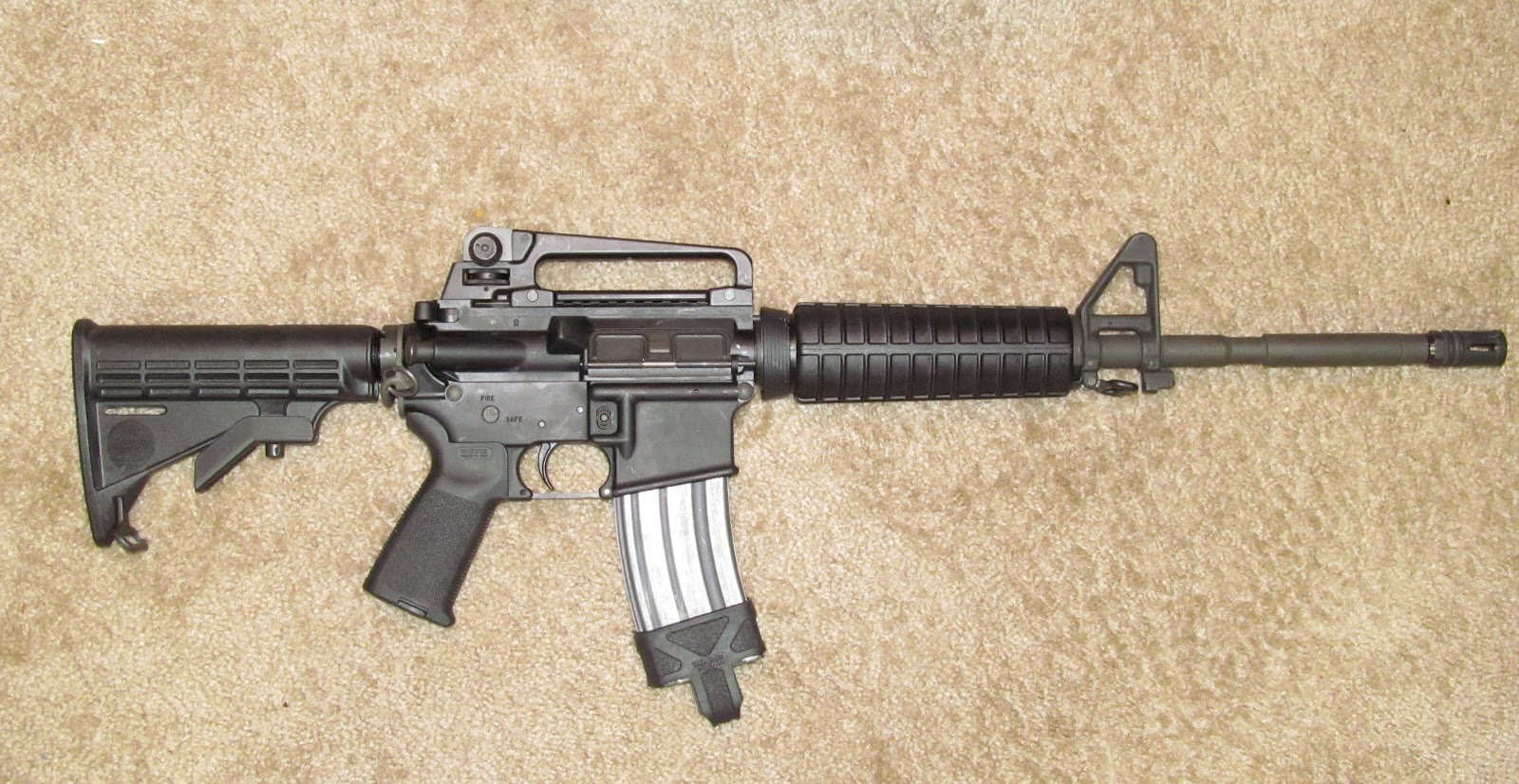
So, what are some advantages/disadvantages of iron sights?  First the good, when it comes to the traditional AR set-up.  They can be very accurate, in Marine Corps boot camp recruits shoot out to 500 yards with iron sights, at human sized targets, and most get a high percentage of hits.  They also are generally easy to make adjustments on for different ranges, and for the wind.  Once you get the sights zero'd, you can mark their positions, and it is easy to return to that zero after making adjustments.  It is also generally very hard to break your iron sights, they are rather robust, and can take a good amount of abuse.  The bad is that with the standard set-up, there is no contrast between the color of the sights, which can make proper sight alignment hard to achieve.  Also, since it is a peep style sight, it is hard to shoot accurately with both eyes open at distance, which reduces your field of view.  Also, there is no magnification to assist in aiming and target identification.  Below is a picture of a typical AR-15 with the standard iron sights and carrying handle


In the last decade, the U.S. military began issuing optics to everyone in combat arms, and in my humble opinion as a former infantryman, that is one of the biggest technological leaps in infantry small arms post World War Two.  Particularly the Marine Corps ACOG, which doesn't require batteries, is very rugged, easily compensates for range while helping you judge distance, and has a low power of magnification.  For general use, I like the 3-4 power range for most rifles.  If you are trying to enter into precision competitions, that probably isn't going to be enough magnification, but, for general use inside 600 yards or so, that should be plenty to get you on target.  It is powerful enough that it is useful, but not so powerful it detracts from what modern optics do so well.   My rifle currently has a no magnification red dot sight on it made by Aimpoint, however, if I wanted to, I could buy a 3 power magnifier with a flip to the side mount to use in conjunction with it.

So, what is it that they do so well?  The first thing is they help with quick target acquisition.  Not only do many of them have some sort of illuminated reticle, it means you only have one focal plane to focus on, so there is no sight alignment that you need to take time to line up.  You can also usually adjust the brightness and size of the dot, for different conditions or more precise shooting.  And in low/no light conditions, the illuminated dot is much easier to use that black on black iron sights, allowing for faster, more accurate shots.


The next advantage has to do with something that is known as the Bindon Aiming Concept.  I am not going to even attempt how the concept actually works inside our body, but with a red dot sight the advantages are quickly obvious.  With a low magnification red dot or holographic optic, like 0-4 power, if you have the optic in front of your dominant eye, and have both eyes open, you don't really see the optic itself.  Your sight picture is basically the dot or reticle floating in the air in front of you, and your hits go where you place the dot on the target.  It is hard to explain in text, but very easy to show students, and it is very easy to tell when it clicks for students using optics.  The faster target acquisition, better target identification abilities, and full use of peripheral vision are some of the main reasons I believe the military went to issued optics.

So, now for the downsides on optics.  First, quality ones are expensive.  The top holographic sights are made by EOtech, the top red dots by Aimpoint, and then Trijicon has their ACOG line, which are kind of fiber optic.  You can look through their catalogs, but you are looking at spending at least a few to several hundred dollars for one of these optics.  Next is that they can break, especially the ones from lower tier manufacturers.  Also, the batteries in them can die, although with some it isn't too much of an issue.  The Aimpoint I have on my AR-15 has a 50,000 hour battery life on some of the lower settings.  And they add extra bulk and weight to your rifle.


Now, the good news, is that as you can see in the picture above, you don't actually need to choose between the two. Many people run both an optic, and what is know as a Back Up Iron Sight (BUIS).  A BUIS is a stand alone rear sight, some of them fold, some of them don't, that replaces the rear sight in the traditional carrying handle.  I prefer non-folding for most applications, because it is one less moving part to break, and I can transition instantly from the dot, to iron sights.  This option really is only available if you have a removable carrying handle.  If you have a rifle with a permanent carrying handle, I would recommend sticking with the iron sights.  While they do make mounts that allow you to put an optic or scope on the carrying handle, that generally places the sight too hight above the bore axis of the rifle to work well.  It also is generally to high to get a good solid cheek weld, and can make shooting a bit uncomfortable.  But, back to removable carrying handle rifles, you can have both a BUIS, and an optic.  If you want to run a full sized scope, you can still find a folding BUIS that can fit under the rear of the scope, so that you can take the scope of and use it if you need to.  But I am of the opinion that you should always have a BUIS in case your optic fails, which also means you need to know how to use irons.

One of the great things about the AR family of rifles is that they are very versatile, and you can adapt them to fit a lot of different roles.  From hunting, to target shooting, to high power competitions, to defensive usage.  There are hundreds of different sight options for them, and you need to find the one that works best for you. But hopefully this post shed a little bit of light on the options, and will help guide you along the way to selecting the right one for you.